1. The Cosmic Framework of Mathematical Discovery
Picture a young shepherd, thousands of years ago, standing at the edge of a valley as dusk falls. His flock scatters across the hillside, and he faces a problem that has no name yet: How many sheep are there? He cannot count them—not because he is ignorant, but because counting, as we know it, does not exist. The number "seventeen" is an invention that lies millennia in the future. For now, all he knows is "one, two, many."
This is the starting point of the Fifth Great Lesson, known as "The Story of Numbers"—the final pillar in Maria Montessori's architectural masterpiece of Cosmic Education. It is a story not about memorizing multiplication tables or drilling arithmetic facts, but about one of humanity's most astonishing achievements: the invention of mathematics itself.
Why This Story Matters: Mathematics is often presented to children as a dry, abstract subject—a collection of rules to be memorized and procedures to be followed. The Story of Numbers reveals it as something far more remarkable: a dramatic human adventure, a tool forged in the fires of necessity, and a universal language that connects every civilization across time.
The Architecture of Cosmic Education
The Fifth Great Lesson does not stand alone. It is the culmination of a carefully designed curriculum that begins with the birth of the universe itself. Cosmic Education proposes a radical idea: that all knowledge is interconnected, and that the child's intelligence is best served by presenting the "whole" before the "parts."
Think of it as a mental coat rack. When you give a child a vision of the entire cosmos—how stars formed, how life emerged, how humans arrived and invented language—you give them a framework upon which all subsequent details can be hung. The Story of Numbers is the fifth and final hook on that rack, showing how humanity developed the abstract tools to quantify, measure, and ultimately understand the universe itself.
First Great Lesson
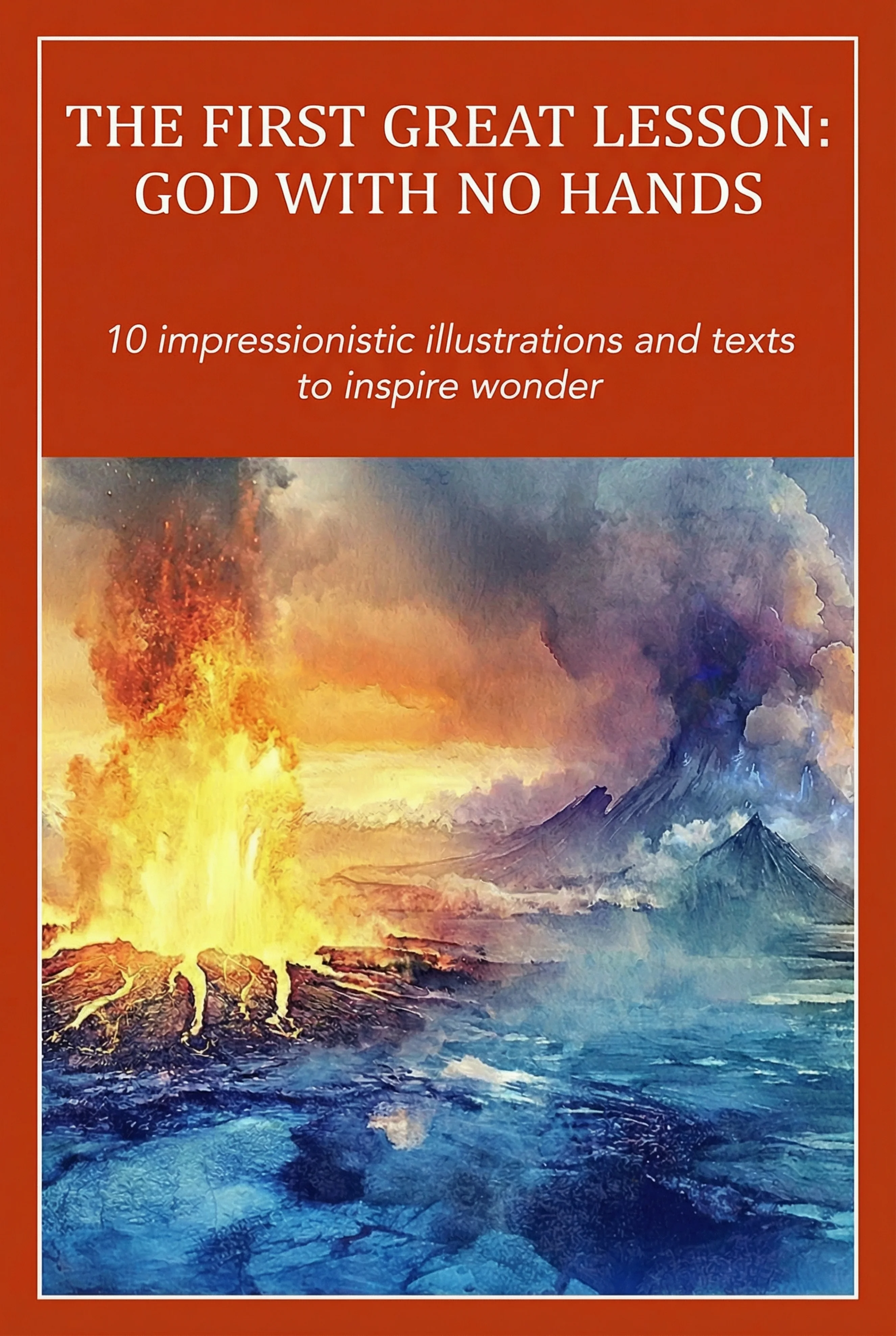
The Story of the Universe: How the cosmos formed, how particles became elements, and how Earth was born from stardust.
Second Great Lesson
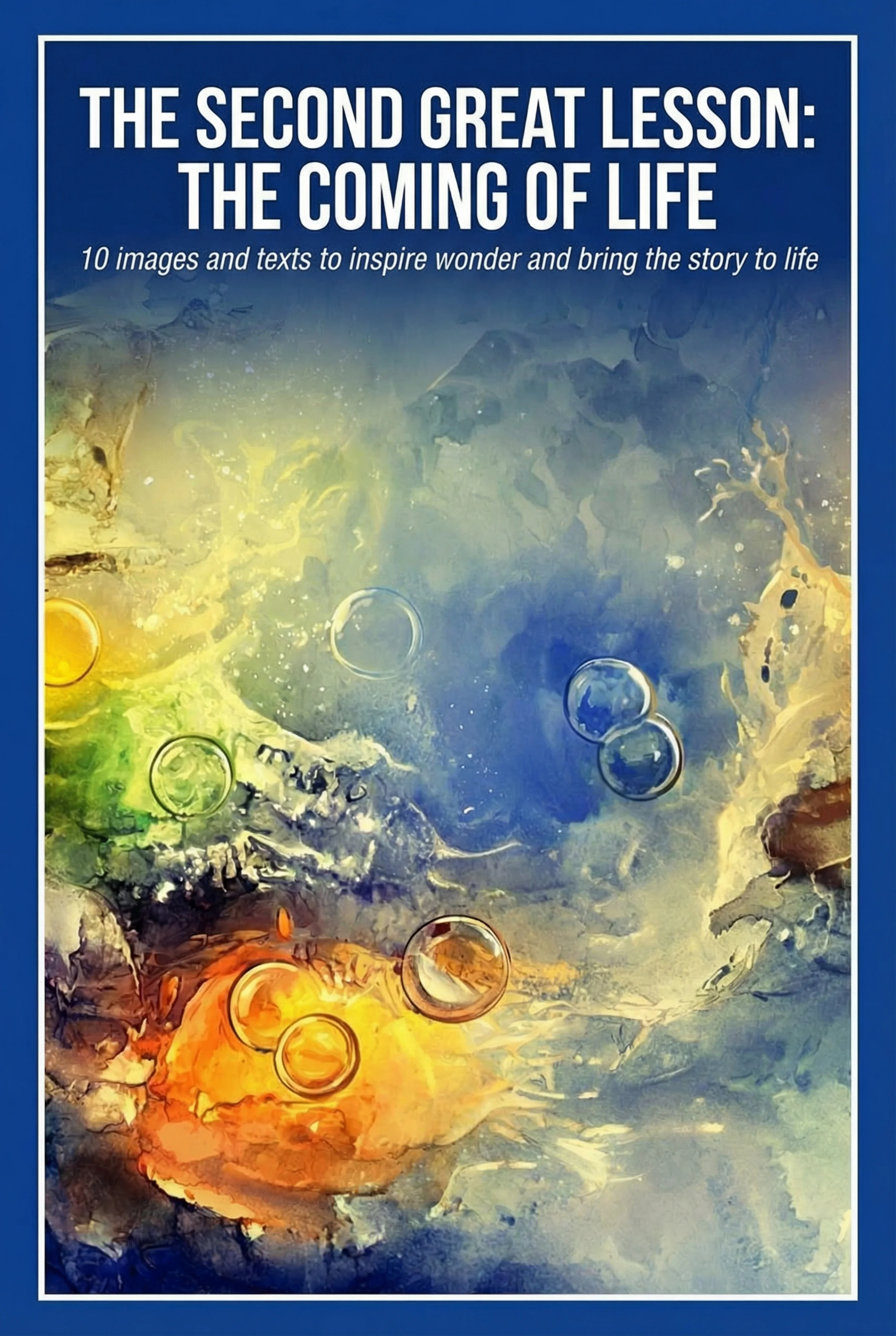
The Coming of Life: How single cells evolved into the magnificent diversity of species that populate our planet.
Third Great Lesson
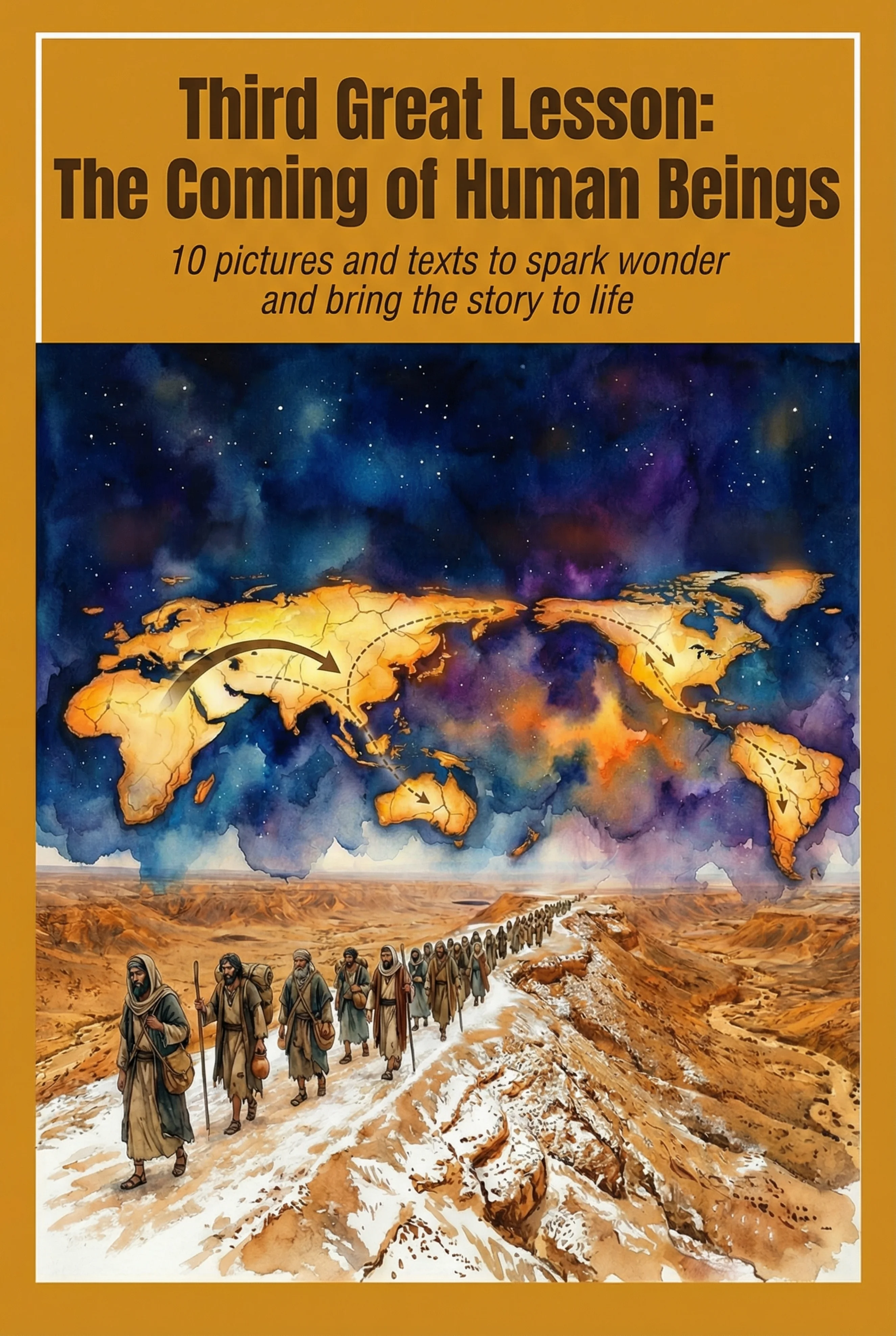
The Coming of Human Beings: How our ancestors developed tools, language, and culture—the three gifts that define humanity.
Fourth Great Lesson
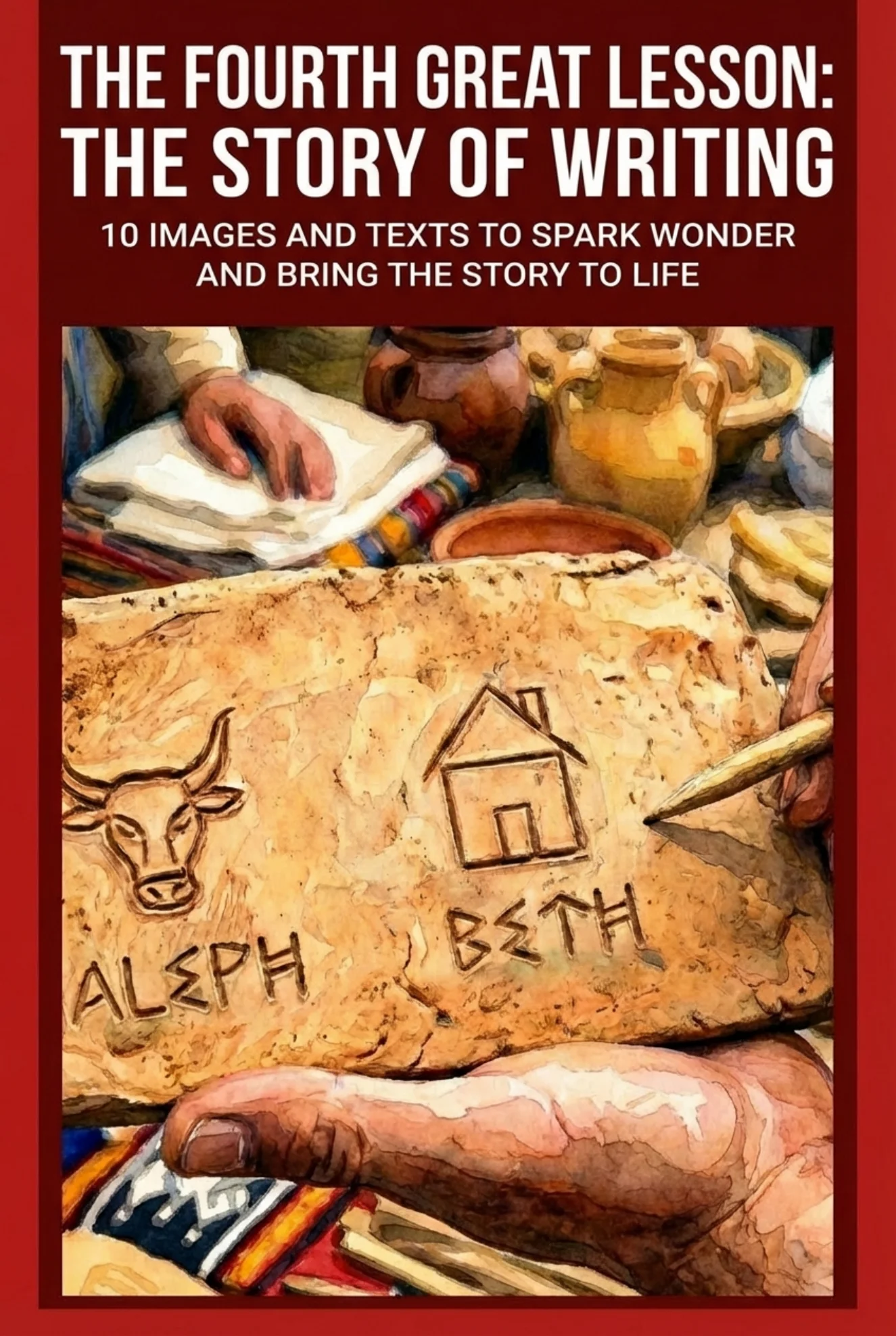
The Story of Writing: How pictographs became alphabets, allowing thoughts to travel across space and time.
Fifth Great Lesson
The Story of Numbers: How humans invented systems to count, measure, and calculate—from tally marks to the decimal system.
Mathematics as Human Achievement
What makes the Story of Numbers so powerful is its revelation that mathematics is not a pre-existing truth that humans discovered, but a "supra-nature" that humans created. Unlike the laws of physics, which exist whether we understand them or not, the number zero had to be invented. The decimal system had to be designed. The concept of place value—the idea that a digit's position determines its value—was a revolutionary intellectual leap that took thousands of years to achieve.
"If the idea of the universe is presented to the child in the right way, it will do more for him than just arouse his interest, for it will create in him admiration and wonder... The child's mind then will no longer wander, but becomes fixed and can work."
— Maria Montessori, To Educate the Human Potential
When children understand that mathematics was invented by people just like them—people who faced problems, struggled with limitations, and came up with ingenious solutions—something shifts. The subject is no longer an alien imposition from the world of adults. It becomes a human heritage to which they are heirs, and to which they can contribute.
This is the promise of the Fifth Great Lesson: to transform mathematics from an obligation into an adventure, from a source of anxiety into a source of wonder.
2. The Mathematical Mind: Humanity's Hidden Gift
What if the human brain came pre-wired for mathematics? Maria Montessori believed it did. She borrowed a term from the French philosopher and mathematician Blaise Pascal—mens mathematica, the Mathematical Mind—to describe something remarkable: every child is born with an innate drive toward precision, order, and the discovery of patterns.
This is not a special talent found only in future mathematicians or scientists. It is a universal human characteristic, as fundamental to our species as language or the use of tools. The Mathematical Mind is the faculty that allows humans to organize sensory experiences, categorize abstract concepts, and perceive relationships between disparate elements. It is the reason a toddler will spend twenty minutes arranging blocks by color, or why a six-year-old becomes fascinated by the patterns in a flower's petals.
The Key Insight: Mathematics is not foreign to the child's nature—it is an expression of it. The Fifth Great Lesson works because it aligns with the child's innate drive to understand, categorize, and find order in the world.
The Absorbent Mind and Mathematical Awakening
In the first six years of life, the child possesses what Montessori called the "Absorbent Mind"—a mechanism for unconscious assimilation of the environment. During this phase, the mathematical mind absorbs the "mathematics" of the world without conscious effort: patterns, rhythms, dimensions, sequences, and spatial relationships. A child stacking cups is doing mathematics. A child clapping to a song is doing mathematics. They don't know it yet, but the foundations are being laid.
By age six, something shifts. The child enters what Montessori called the "second plane of development," characterized by a powerful Reasoning Mind and a burning imagination. Now the child asks "Why?" and "How?" They no longer accept the world as given—they want to understand its underlying structure. This is the perfect moment for the Story of Numbers, which feeds both the imagination (through dramatic narrative) and the reasoning mind (through logical explanation).
First Plane (0-6 years)
The Absorbent Mind unconsciously takes in mathematical concepts: quantity, sequence, pattern, and spatial relationships through direct sensory experience.
Second Plane (6-12 years)
The Reasoning Mind actively questions mathematical concepts. The child asks "How did people invent numbers?" and seeks to understand the invisible structures behind reality.
Abstraction and Imagination
Here lies a beautiful paradox at the heart of Montessori mathematics: mathematics is the most abstract of all sciences, yet Montessori approaches it through the most concrete means. This paradox is resolved through understanding that abstraction is a process, not a starting point.
The Story of Numbers provides the imaginative hook. Through the narrative, the child visualizes the struggles of early humans who lacked numbers. They imagine a world where "one, two, many" was all anyone could say. They empathize with the ancient shepherd who cannot account for his flock or the merchant who cannot track his grain. This imaginative engagement activates the mathematical mind, creating an intellectual hunger.
"Imagination does not become great until human beings, given the courage and the strength, use it to create."
— Maria Montessori
Then comes the concrete experience—the Golden Beads, where a single bead represents one and a cube of thousand beads can be held in the hand. The Stamp Game, where colored tiles represent values. The Bead Frame, where exchanges between columns teach place value through physical manipulation. Only after these concrete experiences does the child naturally transition to abstraction.
The Spiritual Dimension of Mathematics
Beyond intellectual utility, Montessori saw mathematics as having a spiritual dimension. It is a language that transcends borders and eras, a "universal language" that unites humanity in a common quest for truth and precision. The Babylonian who calculated the movements of stars and the modern physicist who tracks subatomic particles are engaged in the same fundamental activity—using mathematical tools to understand the cosmos.
The Story of Numbers teaches that mathematics is not a tool of oppression or exclusion, but a mechanism for cooperation. It was born from the need to share, to trade fairly, and to organize society for the collective good. When early humans invented numbers, they were not just solving practical problems—they were, unconsciously, building the framework for civilization itself.
Validating the Child's Struggle: The story teaches children that if it took humanity thousands of years to invent the concept of zero, they need not feel discouraged by the challenges of long division. Mathematics is hard because it is genuinely difficult—even for our species. But we can do hard things. We have been doing hard things for millennia.
3. The Story Begins: The Parable of the Shepherd
The narrative of the Fifth Great Lesson is a dramatic retelling of human ingenuity. While specific scripts vary between teachers and training centers, the core arc remains consistent—tracing the evolution of numeration from the concrete to the abstract, and from simple correspondence to positional notation.
The Prelude: A World Without Numbers
The story begins in the mists of prehistory, revisiting the early humans introduced in the Third Great Lesson. The narrative establishes that early humans, living in small tribes, had little need for complex numbers. Their possessions were few, and their communities were small. Simple linguistic terms like "one," "pair," and "many" sufficed for daily life.
But as humans settled, domesticated animals, and began to trade, the need for precision arose. How do you trade fairly if you cannot count? How do you know if all your sheep have returned from pasture if you cannot account for them? The limitations of human memory and the body became apparent. While fingers and toes provided the first "counting machine," they were transient and limited in capacity. You cannot carry your fingers to the marketplace to prove how many sheep you own.
"Imagine a shepherd who releases his sheep each morning to graze on the hillside. The sun rises, the gate opens, and the woolly creatures scatter across the valley. By evening, when the sky turns orange and purple, they must return. But how does the shepherd know if they have all come home? He cannot count them—there is no number seventeen in his language, no number forty-three. If a wolf has taken one, how would he ever know?"
One-to-One Correspondence: The Birth of Counting
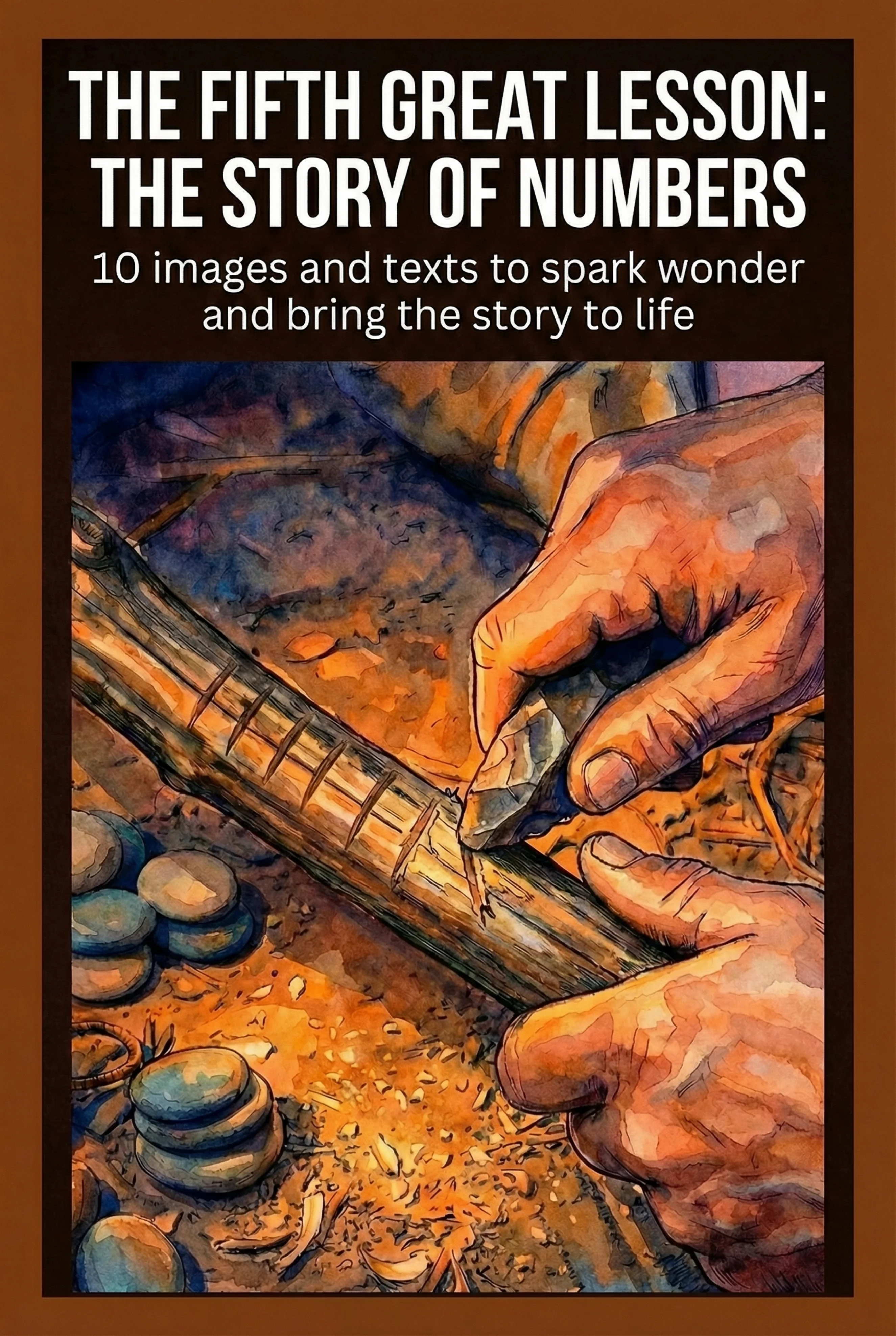
The teacher describes a shepherd who discovers a brilliant solution. He collects a pile of pebbles. As each sheep passes out of the gate in the morning, he moves one pebble from the pile into a leather bag. Each sheep, one pebble. One sheep, one pebble. One-to-one correspondence.
In the evening, as the sheep return, he reverses the process—taking one pebble out of the bag for each sheep that enters the gate. If the bag is empty when the last sheep has passed, all are accounted for. If pebbles remain, he knows to search the hills for the lost ones.
The Birth of Mathematics: This parable illustrates the fundamental concept of arithmetic: the representation of a physical quantity (a sheep) with a symbolic object (a pebble). This is the birth of the "noun" of mathematics—the number itself. From this humble beginning, all of mathematics would eventually grow.
From Pebbles to Permanent Records
The pebble system works, but it has limitations. What if the shepherd needs to remember how many sheep he had last year? What if he wants to record a debt? Pebbles can be lost, scattered, stolen. The story proceeds to explore how different cultures solved the problem of recording quantities permanently.
The narrative moves geographically and chronologically, showcasing the diversity of human invention:
"People began marking wood or bone to keep records. A notch for each sheep, a groove for each jar of grain. The tally mark—a simple vertical line—is one of the oldest and most enduring forms of writing numbers. Even today, when keeping score in a game, we might make four lines and then a fifth that crosses them: IIII crossed by a diagonal. This is mathematics that is tens of thousands of years old, still living in our fingers."
"In the Andes mountains of South America, the Inca people developed an ingenious system called the quipu—knotted cords of different colors hung from a main string. The position of the knot, the color of the cord, the direction of the twist—all carried mathematical meaning. Without writing a single word, they could record populations, harvests, and tributes across a vast empire."
"The word 'calculate' comes from the Latin 'calculus,' meaning 'small stone' or 'pebble.' Every time we calculate, we echo that ancient shepherd moving stones from pile to bag."
— Etymology of Mathematics
The children learn that mathematics did not emerge from one culture or one brilliant individual, but from countless people across the globe, each facing similar problems and devising their own solutions. This diversity of invention is both a historical fact and a pedagogical opportunity—it shows that the mathematical mind is a human universal, not the property of any single civilization.
4. Ancient Number Systems: A World of Mathematical Invention
The story travels across continents and centuries, showing children that mathematics was not invented once, in one place, by one genius. It emerged independently in civilizations around the world, each developing ingenious systems suited to their needs. The Fertile Crescent, the Nile Valley, the Yellow River, the Mediterranean—wherever humans settled and traded, number systems arose.
The Sumerians and Babylonians
Mesopotamia, circa 3000 BCE
In the land between two rivers—the Tigris and the Euphrates—the Sumerians pressed wedge-shaped marks into wet clay using a reed stylus. This "cuneiform" system recorded quantities of grain, numbers of sheep, astronomical observations. But what makes the Babylonians extraordinary is their choice of base: sixty. Not ten, as we use today, but sixty—a sexagesimal system.
Why sixty? Perhaps because sixty has so many divisors—1, 2, 3, 4, 5, 6, 10, 12, 15, 20, 30, 60—making division simpler. Whatever the reason, the Babylonians' choice echoes through the ages. Every time we note that an hour has 60 minutes, or a minute has 60 seconds, or a circle has 360 degrees, we are using Babylonian mathematics.
The Egyptians
Nile Valley, circa 3000 BCE
The Egyptians developed a beautiful system of hieroglyphs for numbers. A single stroke for one. A hobble for cattle representing ten. A coil of rope for one hundred. A lotus flower for one thousand. A finger pointing to the sky for ten thousand. And most memorably—the "Man in Astonishment" (the god Heh), a figure with arms raised to the sky, representing one million.
The Egyptians built the pyramids using this system, calculated the area of fields after the Nile flooded (giving us the word "geometry" from "geo" meaning earth and "metron" meaning measure), and tracked the movements of stars. Their system was base-10, like ours, but lacked place value—which meant writing large numbers required many symbols.
East and West: Parallel Innovations
Chinese Rod Numerals
The Chinese developed a system using bamboo rods placed in patterns. Vertical lines and horizontal lines combined to represent quantities. They also invented one of the first calculators—the counting board (suanpan), ancestor of the abacus.
Greek Numerical Letters
The Greeks assigned numerical values to their alphabet: alpha (α) = 1, beta (β) = 2, and so on. This alphanumeric system influenced later European mathematics and shows how closely number and language are connected.
The Crisis of Complexity: Roman Numerals
A significant portion of the story is often dedicated to the Roman numeral system. The narrative acknowledges the power of the Roman Empire—its roads, its laws, its engineering marvels—but highlights the mathematical clumsiness of their number system.
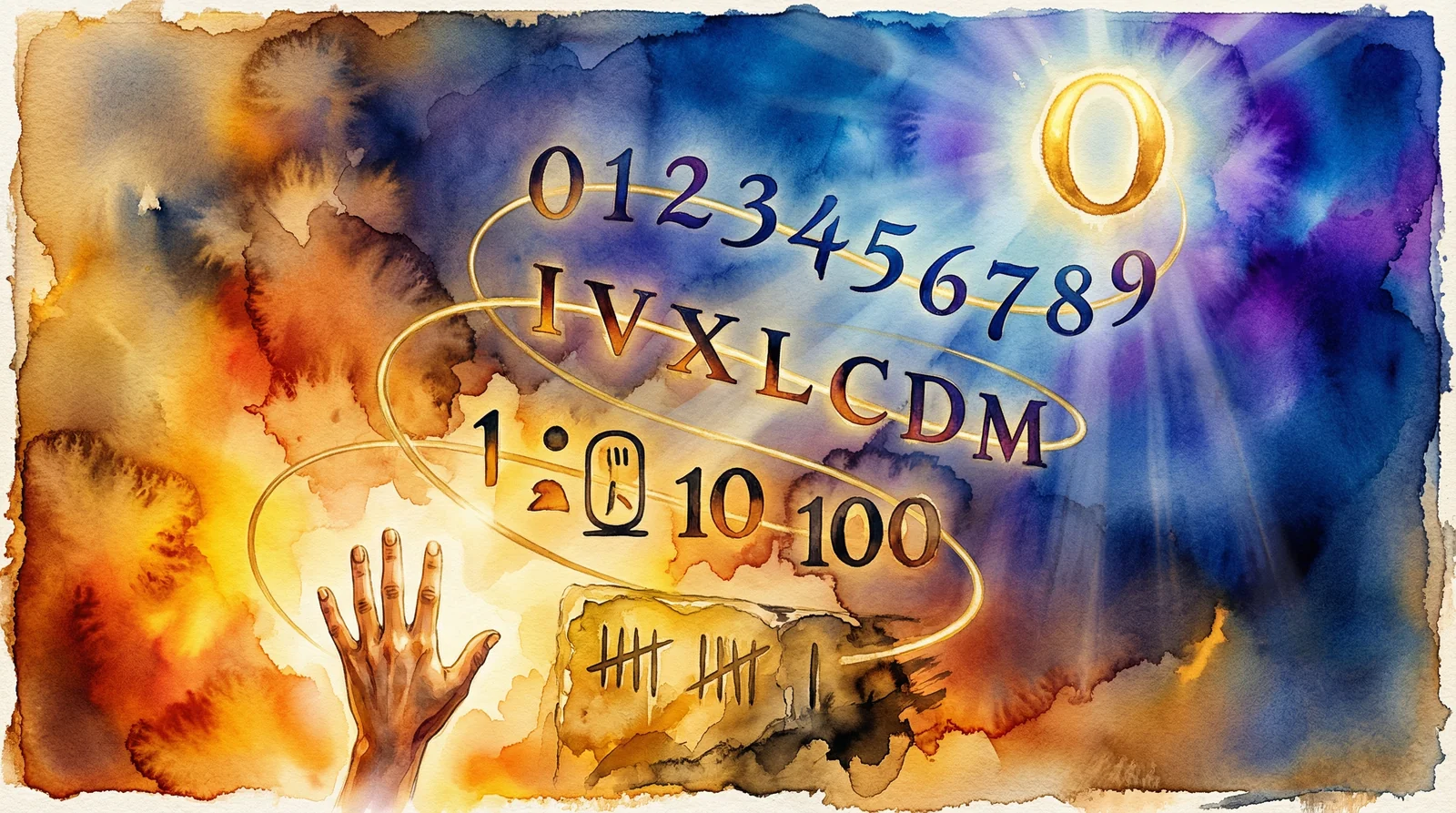
I, V, X, L, C, D, M. Seven symbols. No place value. No zero.
The Challenge: The teacher might ask the children: "Imagine trying to multiply MCCXIV by XLIII using only these letters!" This vividly demonstrates the limitations of a system that lacks place value and zero. Addition is cumbersome. Subtraction is confusing. Multiplication is nearly impossible. The Romans built aqueducts and conquered nations, but their mathematics was primitive compared to what was developing in the East.
This creates narrative tension. Surely there must be a better way? And there was. The solution came not from Rome or Greece, but from the Indian subcontinent—a gift that would eventually transform the entire world.
"The Roman system shows us that even a powerful civilization can be held back by the tools it uses. Mathematics is not just about numbers—it is about the systems that allow us to think with those numbers."
— Montessori Mathematics Principle
5. The Gift of India: Zero and the Revolution of Place Value
Now comes the climax of the story—the moment when the teacher's voice might drop to a whisper, when the children lean forward, when mathematics transforms from a collection of clumsy systems into the elegant, powerful tool we use today. The scene shifts to India, where mathematicians achieved what no civilization before them had accomplished: they invented a symbol for nothing.
The Conceptual Leap: Something for Nothing
Think about how strange this idea is. The Babylonians could count sheep. The Egyptians could measure pyramids. The Greeks could prove theorems. But none of them had a number for "no sheep," "no pyramids," "no quantity at all." They might leave a space to indicate absence, but they had no symbol—no mathematical object—that represented emptiness.
The Indian mathematicians, influenced perhaps by Buddhist and Hindu concepts of the void (śūnya), took the revolutionary step of treating nothing as something. They created a symbol—a small circle, a dot—that represented absence with the same mathematical dignity as presence. Zero was born.
Why Zero Changes Everything: Zero allows for place value. In Roman numerals, each symbol has a fixed value: X always means ten. But with zero and place value, the same digit can mean different quantities depending on its position. The digit "5" in 5, 50, and 500 represents five units, five tens, or five hundreds. This single innovation made complex arithmetic not just possible, but practical.
The Journey West: Hindu-Arabic Numerals
The Indian numerals did not stay in India. Trade routes carried silk, spices, and ideas across the ancient world. Scholars in the Islamic world—in Baghdad's House of Wisdom, in the libraries of Al-Andalus—encountered these remarkable numerals and recognized their power.
The Persian mathematician Muhammad ibn Musa al-Khwarizmi wrote a treatise on the Indian system of numerals, introducing it to the Islamic world. His name gives us the word "algorithm." He also wrote a foundational text on solving equations, giving us the word "algebra" (from "al-jabr," meaning "restoration").
Through the Islamic world, the numerals traveled to Spain and North Africa, where a young Italian merchant would encounter them.
Leonardo of Pisa, later known as Fibonacci, was the son of a merchant who traded in North Africa. There, young Leonardo learned the Hindu-Arabic numeral system from Arab traders. He recognized its superiority immediately. In his book Liber Abaci (The Book of Calculation), he introduced these numerals to Europe, demonstrating how they made arithmetic vastly easier than the Roman system used by European merchants.
"The nine Indian figures are 9 8 7 6 5 4 3 2 1. With these nine figures, and with the sign 0 which the Arabs call zephir, any number may be written."
— Leonardo Fibonacci, Liber Abaci (1202)
A Universal System Emerges
The story concludes with the global adoption of the Hindu-Arabic numeral system. Despite initial resistance—some European cities banned the new numerals, fearing fraud—their practical superiority was undeniable. Merchants, scientists, astronomers all eventually adopted them.
Ease of Calculation
Addition, subtraction, multiplication, and division became straightforward procedures that anyone could learn, not arcane arts practiced only by specialists.
Scientific Revolution
Without Hindu-Arabic numerals, the scientific revolution would have been impossible. Copernicus, Galileo, Newton—all depended on mathematics that Roman numerals could never have supported.
The Digital Age
Every computer today operates on binary—a place value system using just two digits: 0 and 1. The concept of zero makes the digital revolution possible.
The story ends with a vision of connection: the same numeral system that allows a child to do their homework today allowed ancient astronomers to predict eclipses, medieval merchants to balance their books, and modern scientists to calculate the trajectories of spacecraft to distant planets. Mathematics is humanity's shared inheritance, a gift passed from India through the Islamic world to Europe and now to the entire globe.
6. Materials and Methodology: The Architecture of the Lesson
The delivery of the Story of Numbers is supported by a specific set of impressionistic materials and concrete manipulatives that distinguish the Montessori approach from traditional textbook learning. These materials are not merely visual aids—they are teaching tools designed to appeal to the child's imagination and provide bridges from concrete experience to abstract understanding.
Impressionistic Charts
Unlike reference posters that simply display information, impressionistic charts are used during the storytelling to visualize abstract concepts. Their purpose is not to be studied but to be experienced—to create a lasting impression that the child can return to through memory.
| Chart Name | Description & Pedagogical Function |
|---|---|
| Early Counting | Depicts fingers, toes, piles of stones, and notches on sticks. Used to illustrate the primitive "one-to-one correspondence" phase of history. |
| Babylonian Numerals | Shows cuneiform symbols (wedges) on clay tablets. Introduces the concept of base-60 and the use of tools (stylus) to record data. |
| Egyptian Hieroglyphs | Displays the distinct symbols for 1, 10, 100, 1,000, 10,000, 100,000, and 1,000,000 ("Man in Astonishment"). Demonstrates a base-10 system without place value. |
| Roman Numerals | Lists I, V, X, L, C, D, M. Used to contrast with the decimal system and highlight the difficulty of arithmetic without place value. |
| History of Zero | Illustrates the "empty space" in Babylonian texts versus the Mayan shell and the Indian dot/circle. Highlights the intellectual leap of symbolizing "nothing." |
| Journey of Numerals | A map or flow chart showing the migration of numerals from India to the Arab world (Al-Andalus) and finally to Europe via Fibonacci. |
The Timeline of Numbers
Alongside the charts, the "Timeline of Numbers" is a key material. This is often a long scroll—similar to the Timeline of Life—that places mathematical inventions in chronological order alongside other historical events. It allows children to see that the invention of zero or the development of algebra happened in specific historical contexts, often parallel to the rise and fall of great civilizations.
Research Cards: The timeline is accompanied by a set of cards with an image on the front and a short historical narrative on the back. These cards serve as the bridge to independent work; after the lesson, children can take a card (e.g., "Ahmes' Papyrus" or "Brahmi Numerals") and use it as a starting point for their own research report or presentation.
Concrete Manipulatives: The Passage to Abstraction
While the Story of Numbers provides historical context, the practice of mathematics is supported by a sequence of materials that guide the child from concrete quantity to abstract operation. This sequence is meticulously designed to support the Mathematical Mind.
The Golden Beads
The foundational material representing the decimal system geometrically. A single bead is a unit (a point). A bar of ten beads is a line. A square of one hundred beads is a plane. A cube of one thousand beads is a solid.
This material allows the child to "hold" the number 1,000 in their hand, making the abstract concept of place value physically tangible. The progression from point to line to plane to solid mirrors the geometric progression of powers of ten.
The Stamp Game
A step toward abstraction. The beads are replaced by small colored tiles (Green for 1, Blue for 10, Red for 100, Green for 1000). The physical size of the object no longer corresponds to its value; the value is determined by color and symbol.
This shifts the child's understanding from "quantity" to "symbol"—a crucial step in the journey from concrete to abstract mathematics.
The Bead Frames
Resembling abacuses, these frames allow for operations with numbers into the millions. They require the child to understand the concept of "exchanging" (carrying/borrowing) without the physical accumulation of beads—ten units exchanged for one ten, ten tens for one hundred, and so on.
The Checkerboard
A color-coded board used for long multiplication. It spatializes the process of multiplying multi-digit numbers, showing visually why partial products shift position—the "zero placeholder" logic that makes place value multiplication work.
The Test Tubes (Racks and Tubes)
Used for long division. This material breaks down the complex algorithm of division into a color-coded, distributive process, making the concept of "sharing" visible. The child physically distributes beads among cups, understanding division as the inverse of multiplication.
"The hands are the instruments of man's intelligence."
— Maria Montessori
7. Curriculum Architecture: Scope, Sequence, and Integration
The Fifth Great Lesson is not a standalone event but the "point of departure" for the entire six-year elementary mathematics curriculum. It acts as the hub from which various spokes of learning radiate. The curriculum is spiral, meaning concepts are revisited at increasing levels of complexity throughout the Lower Elementary (6–9) and Upper Elementary (9–12) years.
Scope and Sequence by Age Level
Focus: Building a solid foundation in the four operations and understanding the decimal system.
- Numeration: Reading and writing numbers up to millions; identifying place value with Golden Beads and numeral cards.
- Operations: Memorization of math facts (addition, subtraction, multiplication, division) using materials like the Snake Game, Strip Boards, and Bead Chains.
- Exploration: Working with Roman numerals and researching simple ancient number systems—Egyptian hieroglyphs, Babylonian wedges.
- Geometry: Introduction to the "Story of Geometry," identifying basic shapes, lines, angles, and their properties.
Focus: Abstraction, advanced operations, and historical analysis.
- Advanced Arithmetic: Multi-digit multiplication and division without materials; operations with fractions and decimals.
- Powers and Roots: Squaring and cubing numbers; understanding square roots and cube roots geometrically and arithmetically.
- Algebra: Using the Binomial and Trinomial Cubes to derive algebraic formulas; solving for unknowns.
- Non-Decimal Bases: Converting numbers between Base-10, Base-2 (binary), and Base-60 (sexagesimal).
- Historical Research: In-depth studies of mathematicians like Al-Khwarizmi, Fibonacci, and Brahmagupta.
Interdisciplinary Connections
In the spirit of Cosmic Education, the Story of Numbers is integrated with other disciplines, preventing the compartmentalization of knowledge. Mathematics is not an isolated subject—it connects to every aspect of human civilization.
Language & Etymology
Children study the origin of mathematical terms. "Geometry" comes from Greek geo (earth) and metron (measure). "Calculation" comes from Latin calculus (pebble)—echoing the shepherd's stones.
History & Geography
The study of numbers is the study of civilizations. Children map the spread of Hindu-Arabic numerals across Asia and Africa to Europe, connecting mathematics to trade routes and cultural exchange.
Science & Biology
Understanding the Fibonacci sequence in nature—pinecones, sunflowers, nautilus shells—links mathematics directly to the "Story of Life" and reveals mathematical patterns in biology.
Practical Life
Application of math in daily life—cooking (measurement), carpentry (geometry), budgeting (economy), and time management connects abstract learning to concrete reality.
The Cosmic Connection: Every time a child learns a mathematical concept, they are invited to see it in context. Learning fractions isn't just about cutting pies—it's about understanding how Egyptian scribes divided grain, how medieval merchants split profits, and how musicians divide time into beats.
The Spiral Curriculum in Action
Montessori mathematics follows a spiral curriculum, where concepts are introduced at a basic level and revisited with increasing complexity. A six-year-old encounters place value through Golden Beads; an eight-year-old applies it in the Stamp Game; a ten-year-old uses it in algebraic expressions; a twelve-year-old understands it through the history of the decimal system's invention.
This spiral approach respects the child's development while building deep, lasting understanding. The Fifth Great Lesson provides the historical and imaginative framework that gives meaning to each turn of the spiral—the child doesn't just learn how to do mathematics, but why mathematics came to be, and why it matters.
8. Ethnomathematics: Expanding the Story
As Montessori pedagogy evolves, there is a growing emphasis on ensuring the Great Lessons reflect current historical scholarship and cultural inclusivity. The traditional "Eurocentric" or "linear" narrative—Sumer to Egypt to Greece to Rome to Europe—is being expanded to embrace a more global perspective, often referred to as Ethnomathematics.
Ethnomathematics is the study of mathematical practices in different cultural contexts. It recognizes that mathematics is not a single invention of one civilization, but a universal human activity that emerged independently in cultures around the world. Including these perspectives enriches the Fifth Great Lesson and serves the Cosmic Education goal of showing the unity of the human spirit.
The Ishango Bone: Rewriting Prehistory
The Ishango Bone
Democratic Republic of the Congo, circa 20,000-25,000 BCE
Traditional Montessori scripts often begin with the Shepherd or Sumerian clay tablets, placing the origin of mathematics around 3000 BCE. But archaeological evidence suggests mathematical thinking predates these civilizations by twenty thousand years.
The Ishango Bone, discovered in the Democratic Republic of the Congo, is a baboon fibula featuring grouped notches. Some mathematicians argue these represent a lunar calendar; others see a table of prime numbers. What is certain is that complex mathematical thinking existed in Africa long before the first Sumerian pressed a stylus into clay.
Including the Ishango Bone in the Fifth Great Lesson challenges the narrative that mathematics began in Mesopotamia and centers African innovation at the dawn of mathematical thought. It validates the mathematical heritage of the African continent and provides a deeper timeline for human ingenuity.
Alternative Number Systems
To demonstrate that the base-10 system is not the only logical way to count, advanced Montessori curricula now incorporate non-decimal systems from cultures around the world.
The Yoruba Number System
West Africa
The Yoruba system is a complex vigesimal (base-20) system that relies on subtraction for high numbers. Unlike our additive system (fifteen = ten + five), Yoruba uses subtraction:
15 in Yoruba is ẹ̀ẹ́dógún = "20 minus 5"
19 is oókàn dín lógún = "20 minus 1"
Studying this system forces children to think flexibly about quantity and logic. It illustrates that "mathematical truth" can be expressed through different cultural lenses, combating the notion that Western mathematical conventions are the only "correct" ones.
Mayan Zero
The Mayans independently invented zero—represented by a shell glyph—centuries before it arrived in Europe. They used a vigesimal system (base-20) and developed sophisticated astronomical calculations.
Inca Quipu
The Incas recorded numerical information using knotted strings called quipus. Position, color, and knot type all carried mathematical meaning—a decimal system without a single written digit.
Independent Discovery: The phenomenon of independent invention—the same mathematical concept arising in separate civilizations without contact—demonstrates that the mathematical mind is a human universal. Zero was invented at least twice: in India and in Mesoamerica. This serves the Cosmic Education goal of showing the unity of the human spirit.
Decolonizing the Narrative
Modern critique suggests that older Montessori scripts focused too heavily on the "lineage to Europe"—presenting Asian, African, and American achievements merely as stepping stones to Western science. A decolonized approach treats these mathematical traditions as destinations in themselves, worthy of study for their own sake.
This involves explicitly naming non-European mathematicians. Al-Khwarizmi, whose name gives us "algorithm" and whose book on equations gives us "algebra," was not merely a transmitter of Indian knowledge but a profound innovator in his own right. The "Golden Age of Islam" was not just a preservation period—it was a peak of mathematical creativity that advanced algebra, trigonometry, and astronomical calculation.
"The more we study the different cultures and their mathematical practices, the more we recognize mathematics as a universal human endeavor—not the property of any single civilization, but the inheritance of all."
— Ethnomathematics Principle
By expanding the Fifth Great Lesson to include these perspectives, we give all children—regardless of their cultural background—mathematical ancestors to admire and emulate. The story becomes not just the history of Western achievement, but the shared human journey toward understanding quantity, pattern, and abstract thought.
9. Comparative Pedagogy: AMI vs. AMS Approaches
While the core of the Fifth Great Lesson is shared across the Montessori world, significant variations exist between the two dominant traditions: the Association Montessori Internationale (AMI) and the American Montessori Society (AMS). These differences reflect distinct historical and cultural trajectories, and understanding them helps educators make informed choices about implementation.
Association Montessori Internationale (AMI)
Founded by Maria Montessori, 1929
AMI tends to adhere closely to the "original" methodology and the oral tradition passed down through training centers. Guides are trained to deliver the Great Lessons as "fables" with a high degree of dramatic flair, often following a specific, traditional script sequence.
The focus is on giving the "keys" to the universe—essential, impressionistic strokes that ignite interest—rather than exhaustive factual detail. AMI classrooms prioritize the classic set of Montessori materials and are often hesitant to introduce supplementary textbooks or non-Montessori worksheets, viewing them as potential distractions from the child's own discovery process.
There is heavy emphasis on the spiritual preparation of the teacher and the preservation of the "purity" of the method. The Great Lessons are strictly presented at the beginning of the year (or cycle) to set the stage, with attention to the "psychological timing" of the presentation.
American Montessori Society (AMS)
Founded by Nancy McCormick Rambusch, 1960
AMS was designed to adapt Montessori education to the American cultural context. Guides may exercise more flexibility in the script, incorporating modern children's literature, multimedia, or updated scientific findings more readily than their AMI counterparts.
AMS classrooms are more likely to integrate state standards, workbooks, and supplementary educational technologies. The Story of Numbers might be supplemented with a unit on computer coding or a project based on modern economic systems.
AMS has placed a strong emphasis on "Equity and Justice" within the curriculum. The Fifth Great Lesson in an AMS context is often explicitly framed to address issues of wealth distribution, the ethics of economic systems, and the contributions of marginalized cultures. Teachers often use more conventional lesson planning and record-keeping structures to align with American public and private school norms.
Comparison at a Glance
| Feature | AMI Approach | AMS Approach |
|---|---|---|
| Script Fidelity | High; adheres to oral tradition and training albums | Flexible; adapts to modern resources and context |
| Supplementation | Minimal; relies on materials and child-led research | Moderate to high; uses workbooks, technology, state standards |
| Primary Focus | Spiritual and psychological development | Developmental plus social and cultural relevance |
| Cultural Narrative | Classic "Cosmic Education" arc | Explicitly integrates DEI (Diversity, Equity, Inclusion) |
| Record Keeping | Observation-based narratives | Often aligns with standard grading and checklists |
| Timing | Strictly at beginning of year/cycle | More flexible; may re-present throughout year |
Shared Core: Despite these differences, both AMI and AMS share the fundamental goal: to awaken the mens mathematica within the child. They agree that mathematics should be presented as a human achievement, that the story must inspire wonder before instruction, and that the child's engagement should drive subsequent exploration.
Finding Your Approach
Whether following the AMI or AMS tradition—or finding a synthesis of both—the teacher's role remains the same: to be a storyteller who unveils mysteries, not a dispenser of information. The teacher must cultivate their own sense of wonder about mathematics. If the teacher views math as a chore, the lesson will fail. They must view themselves as the "Great Storyteller" connecting the child to the cosmos.
"We do not want to teach the facts of astronomy or geology, but to strike the imagination."
— Maria Montessori, To Educate the Human Potential
The best approach is one that honors the spirit of Cosmic Education while meeting the needs of the specific children in your classroom. The story is a living tradition—it can adapt and grow while remaining true to its essential purpose: to help children see themselves as heirs to the great human adventure of mathematical discovery.
10. Conclusion: Walking in the Footsteps of Our Ancestors
The Story of Numbers is far more than a history lesson. It is an invitation to participate in the grand endeavor of humanity. By presenting mathematics as a solution to human problems—a tool forged by shepherds, merchants, astronomers, and philosophers—Montessori pedagogy strips away the anxiety often associated with the subject. It validates the child's natural impulse for order and connects their individual cognitive development to the evolution of the species.
When a child struggles with long division, they are not failing—they are grappling with a challenge that took humanity millennia to solve. When they finally understand why the digits shift in multiplication, they are experiencing the same intellectual thrill that gripped mathematicians from Baghdad to Pisa. Mathematics is not an alien imposition; it is their birthright.
The Three Gifts Revisited
In the Third Great Lesson, children learn about the "Three Gifts" that make humans unique: a mind to imagine, hands to work, and a heart to love. The Story of Numbers shows how these gifts manifest in mathematical creation:
A Mind to Imagine
The ability to conceive of "nothing" as "something"—to invent zero—required pure imagination. So did the leap from counting physical objects to manipulating abstract symbols.
Hands to Work
From the shepherd's pebbles to the child's Golden Beads, mathematics has always been a tactile activity. The hands and the mind work together, each informing the other.
A Heart to Love
Mathematics was born from the need to share fairly, to cooperate, to build civilizations together. It is, at its core, an expression of human connection and care.
Practical Implementation Highlights
For educators implementing the Fifth Great Lesson, several key principles emerge from this analysis:
Teacher as Storyteller: The success of the lesson depends on the presenter. Invest in storytelling training—pacing, voice modulation, dramatic pauses. Internalize the story so you can tell it eye-to-eye with students, not reading from a page. Cultivate your own sense of wonder about mathematics.
Prepared Environment: Have the materials ready for immediate exploration. The timeline should be prominently displayed. Research cards should be accessible. High-quality concrete materials (Golden Beads, Stamp Game, Bead Frames) should be available for children to work with after the story.
Follow the Child: After the story, observe which aspects capture each child's imagination. One may be fascinated by Egyptian hieroglyphs; another by the Yoruba number system; another by the life of Fibonacci. Support their independent research and celebrate their discoveries.
"The child's mind then will no longer wander, but becomes fixed and can work. The knowledge he then acquires is organized and systematic; his intelligence becomes whole and complete because of the vision of the whole that has been presented to him."
— Maria Montessori, To Educate the Human Potential
The Story Continues
Whether implemented through the strict oral traditions of AMI or the culturally adapted approaches of AMS, the core objective remains the same: to awaken the mens mathematica within the child. As the child moves from the concrete weight of the Golden Bead to the abstract dance of algebraic variables, they walk in the footsteps of the ancestors depicted in the Great Lesson.
They realize that they, too, possess the three gifts of humanity—a mind to imagine, hands to work, and a heart to love—and with these, they can continue the mathematical adventure that began with an ancient shepherd counting pebbles on a hillside. They can calculate the orbits of planets, decode the patterns of nature, and perhaps invent mathematical tools that we cannot yet imagine.
The Story of Numbers does not end with Fibonacci or with the modern computer. It continues in every classroom where children discover the joy of mathematics—and in every heart where the mathematical mind awakens to the wonder of the cosmos.