Introduction
Imagine a moment when the simple act of writing a note transforms in a child's mind—no longer a mundane skill, but a link in a chain stretching back thousands of years to cave walls and clay tablets. The Fourth Great Lesson, The Story of Communication in Signs (often called "The Story of Writing" or "The Story of the Alphabet"), creates precisely this magical transformation.
The Montessori elementary curriculum, known as Cosmic Education, is not merely a syllabus of distinct subjects but a unified pedagogical framework designed to correspond with the psychological characteristics of the child in the second plane of development (ages six to twelve). Within this framework, the Five Great Lessons serve as the dramatic opening acts, providing a panoramic vision of the universe, life, and human history.
While the first three stories establish the physical and biological stage—the formation of the universe, the coming of life, and the arrival of humans—the Fourth Great Story marks a critical ontological shift. It transitions the narrative from biological evolution to cultural evolution, exploring how humanity constructed a "supra-nature" through the invention of symbolic systems.
The Transformation: The Fourth Great Lesson reveals writing not as a set of arbitrary grammar rules to be memorized, but as a heroic human achievement—a "technology of power" and connection that solved the existential problem of the fragility of memory.
The elementary child is characterized by a "reasoning mind" and a potent imagination that seeks to understand causes, relationships, and origins. Unlike the child in the first plane (0-6), who absorbs the environment unconsciously, the elementary child consciously constructs their intellect through the exploration of "big pictures."
By framing the alphabet and writing systems as solutions to human needs, the story engages the child's gratitude and sense of social solidarity. It answers the elementary child's burning question: "How did this come to be?" This narrative approach aligns with what historian David Christian calls "Big History," weaving disparate strands of geology, sociology, and linguistics into a coherent story of complexity.
| Feature of Second Plane Child | Pedagogical Response in Fourth Great Story |
|---|---|
| Reasoning Mind | Explains the cause and effect of writing's invention (need for trade/records) |
| Imagination | Uses dramatic vignettes (cave painters, ancient merchants) to visualize the past |
| Hero Worship | Highlights the contributions of specific groups (Phoenicians, Egyptians) |
| Social Interest | Focuses on communication as a bridge between people and cultures |
| Moral Development | Cultivates gratitude for the "gifts" of ancestors (the alphabet) |
In the following sections, we will explore the philosophical dimensions of this remarkable story, its narrative structure, the historical accuracy underlying its claims, the pedagogical methods for presenting it, and contemporary adaptations that honor both traditional wisdom and modern scholarship. We will discover how a story about symbols becomes a story about what makes us human.
I. The Supra-Nature and Human Agency
To fully grasp the import of the Story of Communication in Signs, one must understand Maria Montessori's profound concept of the "supra-nature" (or supernature). Montessori postulated that while animals adapt to their environment, humans adapt the environment to themselves, creating a secondary layer of existence composed of culture, technology, and organized society.
A. The Construction of the Supra-Nature
Writing is arguably the foundational technology of the supra-nature. It allows for the accumulation of knowledge across generations, liberating humanity from the limitations of biological memory and oral transmission. In the Montessori view, the environment of modern humans is no longer "nature" in the raw sense, but this built environment of the supra-nature, which holds human society together through complex webs of interdependence.
The Fourth Great Story illustrates how this supra-nature was built. It depicts early humans not just as survivors, but as agents of creation who "exert a modifying function" upon the world. When a child learns that a Phoenician merchant modified an Egyptian hieroglyph to create a phonetic letter, they are witnessing the construction of the supra-nature in real-time.
The Noosphere
This concept aligns with the philosophical thoughts of Teilhard de Chardin, who influenced Montessori's later work. Chardin suggested that humanity is the "shaper of the landscape" and the builder of the "noosphere"—the sphere of human thought that envelops the Earth. Every symbol written, every idea preserved in text, adds another layer to this collective human achievement.
B. The Moral Mandate: Gratitude and Solidarity
A central aim of Cosmic Education is to foster a sense of gratitude and responsibility. The narrative explicitly invites children to feel a connection with the distant past. The guide might say:
"What you have to remember and be grateful for is the story of the Phoenicians, because they made the first real letters for sounds."
This is not merely historical trivia; it is a moral lesson in interdependence. The child realizes that their ability to read a book today is dependent on the labor and ingenuity of people who lived thousands of years ago. Every letter they write connects them to an ancient Phoenician sailor, a Sumerian accountant, a Greek philosopher.
Cosmic Task Awareness: This awareness of interdependence is intended to combat isolationism and foster "cosmic task" awareness—the idea that every individual has a role to play in the maintenance and advancement of the whole. As the child writes their first sentence, they are joining the "formidable and severe organization" of humanity that works together across time and space.
The Fourth Great Lesson thus transforms writing from a mere skill into a sacred inheritance. The child who understands this story no longer sees a pencil as just a tool—they see it as a bridge connecting them to the collective genius of humankind, carrying the obligation to use it wisely and pass on the gift to future generations.
This philosophical dimension distinguishes Montessori's approach from conventional literacy instruction. While traditional methods may teach the mechanics of writing efficiently, they rarely awaken the child's soul to the cosmic significance of what they are learning. The Fourth Great Lesson ensures that every written word becomes an act of participation in humanity's greatest collaborative project.
II. Narrative Structure: The Three Vignettes
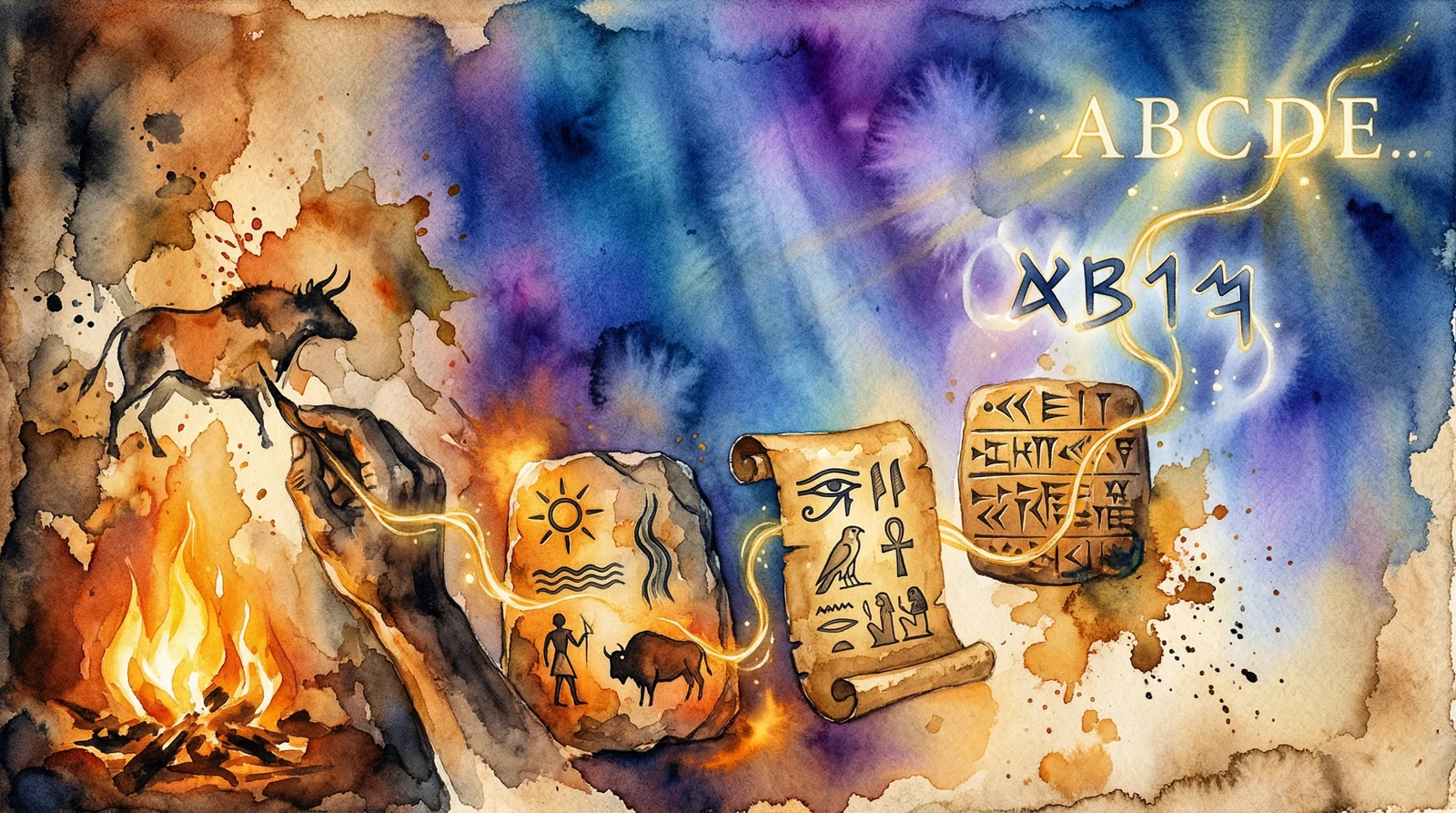
The "script" of the Fourth Great Story is not a rigid text but a dramatic framework. However, there are traditional structures, particularly within AMI training, that provide a consistent narrative arc. The story is often presented as a series of vignettes or "scenes" that personify the major leaps in the history of communication.
A. Vignette I: The Fragility of Oral Tradition
1 The Mists of Pre-History
The story begins in the mists of pre-history, focusing on the oral tradition. The guide describes a time when "nothing could be kept" unless it was remembered. A character is often introduced—perhaps an elder or a storyteller—who realizes that their knowledge will die with them.
This creates the dramatic tension that drives the invention of writing. The first resolution is the cave painting, such as those at Lascaux, where humans first "froze" their thoughts on a wall. This is the era of Pictographs: writing the picture.
B. Vignette II: The Burden of Memory and the Accountant
2 The Dawn of Civilization in Mesopotamia
As the narrative moves to the dawn of civilization in Mesopotamia (Sumer), the problem shifts from "forgetting stories" to "managing complexity." The script frequently introduces a character like "Baran the Accountant."
Baran is depicted as a man overwhelmed by the demands of trade—too many sheep, too many amphorae of oil to remember. The "discovery" moment occurs when Baran realizes he can use clay tokens or mark wet clay to keep count.
This vignette illustrates the transition from pictographs to Ideographs (symbols representing ideas) and the birth of Cuneiform. The narrative emphasizes that writing began not for poetry, but for the "spreadsheets" of the ancient world—a technology of administration and commerce.
C. Vignette III: The Phoenician Simplification
3 The Climax: Invention of the Alphabet
The climax of the story is the invention of the alphabet. The narrative transports the children to the bustling ports of the Phoenicians. The guide describes the Phoenicians as master traders who found the thousands of cuneiform and hieroglyphic symbols too slow and difficult for their rapid business transactions.
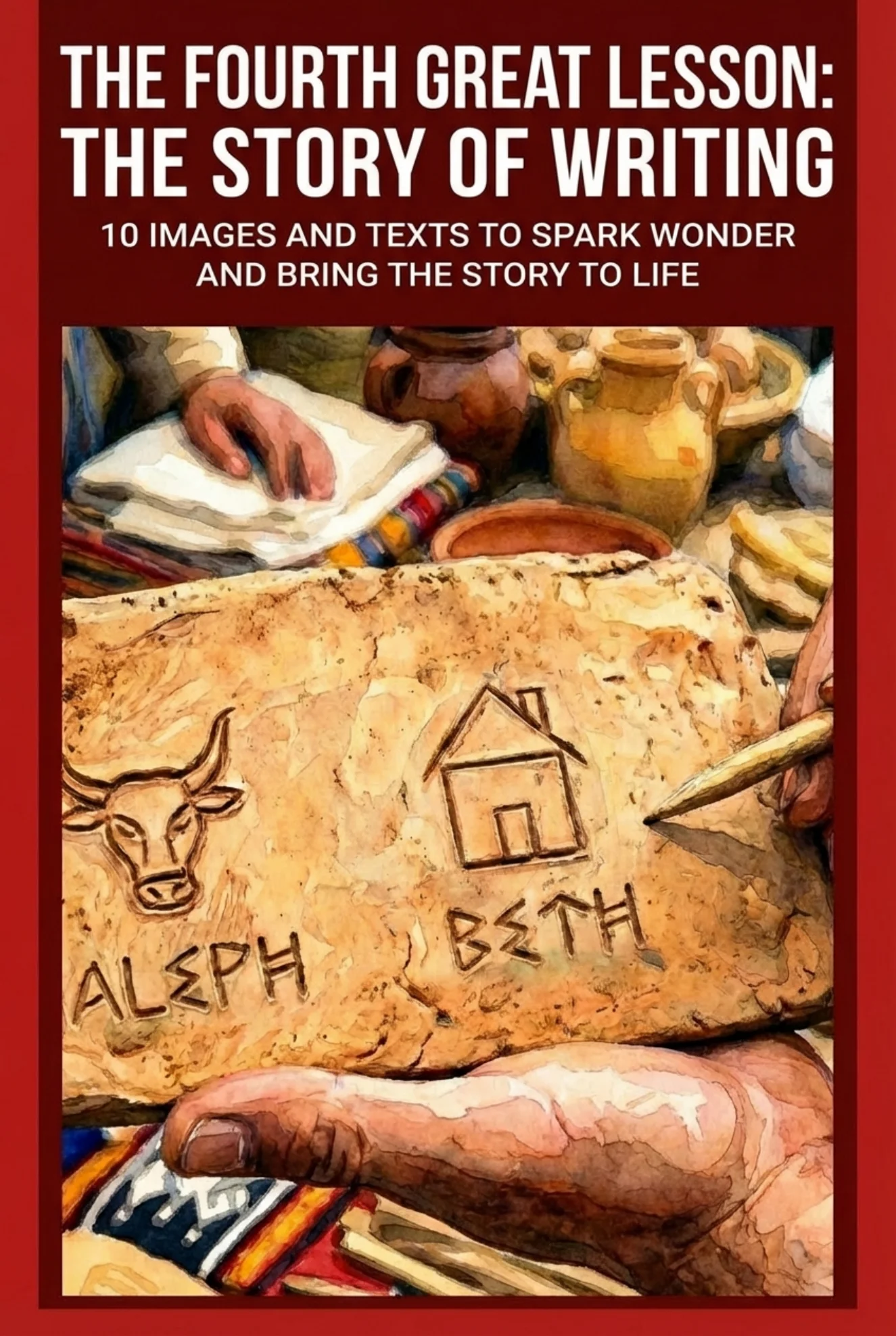
The breakthrough is presented as a moment of genius: the realization that all human speech is made up of a few distinct sounds. The script describes how the Phoenicians took Egyptian symbols (like the ox head) and used them not for the word "ox" (aleph), but for the sound of the first letter (A).
This is the birth of the Phonetic Alphabet. The story concludes with the transmission of this alphabet to the Greeks (who added vowels) and then to the Romans, leading directly to the letters the children see in their classroom today.
The Evolution of Writing: The three vignettes trace a beautiful arc from pictures to ideas to sounds—each step representing a leap in human abstraction and a solution to real-world problems.
Pictographs
Drawing pictures of things: an ox, a house, the sun
Ideographs
Symbols for ideas: marks representing concepts and quantities
Phonetic Alphabet
Letters for sounds: a small set of symbols representing all speech
This narrative structure gives children a logical framework for understanding why writing looks the way it does. They see that the letter "A" was once a picture of an ox head, turned upside down over millennia. The abstract becomes concrete; the arbitrary becomes meaningful.
III. Historical Accuracy and Modern Scholarship
The Great Stories are described as "impressionistic," meaning they prioritize inspiring wonder over exhaustive academic precision. However, modern Montessori scholars and guides strive to ensure the stories align with current archaeological consensus, correcting early 20th-century generalizations.
A. The Proto-Sinaitic Origins
The traditional Montessori story often thanks the Phoenicians directly for the alphabet. However, modern research suggests the alphabet was likely invented earlier, around 1800 BCE, by Semitic workers (possibly turquoise miners) in the Sinai peninsula who adapted Egyptian hieroglyphs. These "Proto-Sinaitic" inscriptions are the true link between hieroglyphs and the Phoenician script.
Linguistically, the script these miners created (and the Phoenicians popularized) was an abjad—a writing system consisting only of consonants. It was the Greeks who later adapted certain symbols to represent vowels, creating the first true alphabet in the technical sense.
Modern Nuance: Modern presentations of the story often include this nuance, explaining that the Greeks gave the letters "voices" (vowels). This doesn't diminish the Phoenicians' role—they were the great transmitters and adapters who spread the system across the Mediterranean world.
B. The Evolution of the Letter 'A'
A specific "Key Lesson" often embedded in the story is the visual evolution of the letter A, demonstrating the principle of acrophony (where a symbol stands for the initial sound of the object it depicts).
Pictograph
The Egyptian hieroglyph for an ox head—a drawing of the animal's face with two horns pointing upward.
Proto-Sinaitic / Phoenician
The symbol becomes simplified. The Semitic word for ox is aleph. The symbol is used to represent the glottal stop (or /a/ sound contextually). It looks like an ox head with horns pointing up or sideways.
Greek
The Greeks adopted the letter, calling it alpha. They rotated it, so the horns pointed down.
Roman
The Romans solidified the shape, with the crossbar connecting the two "legs" (formerly horns), creating the modern A.
C. Independent Invention and Global Context
One of the most significant updates to the traditional narrative is the acknowledgement that writing was invented independently in multiple locations, challenging the diffusionist model that places Mesopotamia as the sole "cradle."
| Civilization | Approx. Date | Script Type | Origin Context |
|---|---|---|---|
| Sumer (Mesopotamia) | ~3200 BCE | Cuneiform | Accounting tokens, clay envelopes |
| Egypt | ~3100 BCE | Hieroglyphs | Royal display, religious texts |
| China (Shang Dynasty) | ~1200 BCE | Chinese Characters | Divination (Oracle Bones), independent invention |
| Mesoamerica (Maya/Zapotec) | ~600-300 BCE | Glyphs | Calendrics, royal history, independent invention |
Including this data prevents the story from being purely Eurocentric. It highlights that the human drive to record information is universal. For instance, the Quipu of the Andes (knotted strings) is often included as an alternative "sign" system that did not use graphic marks but successfully recorded complex data.
Universal Human Achievement: The story of writing is not the story of one culture's triumph—it is the story of humanity's universal drive to defeat time, preserve knowledge, and communicate across distances and generations. This understanding deepens children's appreciation for cultural diversity while strengthening their sense of shared humanity.
IV. AMI vs. AMS Presentation Nuances
While the core narrative remains consistent, there are observable differences between Association Montessori Internationale (AMI) and American Montessori Society (AMS) presentations, often reflecting their differing stances on curriculum evolution.
| Feature | AMI Tradition | AMS / Modern Adaptations |
|---|---|---|
| Narrative Fidelity | Tends to adhere closely to the "Cosmic Fables" as outlined by Mario Montessori. Emphasis on the "psychological key." | More likely to integrate updated historical data, contemporary children's literature, and broader cultural examples. |
| Literacy Approach | Often treats the story as a precursor to formal "word study" and separate grammar analysis (isolating difficulty). | May integrate "Whole Language" approaches, using the story to launch immediate journaling or "invented spelling" activities. |
| Materials | Focus on traditional charts (The Ox and the House) and the Hand Timeline. | Utilization of diverse supplementary books (Ox, House, Stick), digital resources, and teacher-made materials. |
| Scripting | Less likely to use personified names (like "Baran") in official training, focusing on "the people." | Frequently uses personified characters to increase engagement and relatability. |
A. The AMI Approach
Classical Tradition
The AMI approach, maintaining fidelity to the original lectures of Maria and Mario Montessori, tends to utilize a more formal, standardized script that is deeply philosophical.
- Psychological Key: The story serves as a "psychological key" that unlocks the child's interest, with details left for independent exploration
- Impressionistic Visuals: Materials focus on symbolic representation—the Hand Timeline showing how brief human history is compared to Earth's age
- Isolation of Difficulty: The story inspires, while separate lessons teach the mechanics of writing
- Universal Language: Scripts avoid overly specific cultural references to maintain applicability across different contexts
B. The AMS and Modern Approach
Adaptive Evolution
AMS-aligned programs and modern curriculum designers often adapt the story to be more culturally inclusive and scientifically detailed.
- Contemporary Literature: Integration of books like "Ox, House, Stick: The History of Our Alphabet" by Don Robb
- Personified Characters: Names like "Baran the Accountant" create emotional connection and memorability
- Scientific Updates: Explicit inclusion of Proto-Sinaitic origins and multiple independent inventions of writing
- Digital Resources: Use of interactive timelines, virtual museum tours, and multimedia presentations
- Whole Language Integration: Immediate journaling activities connected to the story themes
The Common Ground: Both traditions share the same fundamental goal: to inspire wonder and gratitude for the gift of written communication. The choice between approaches often depends on the specific needs of the children, the training of the guide, and the available resources. Many educators find value in drawing from both traditions.
Regardless of which tradition a guide follows, the essential elements remain constant: the dramatic presentation, the emphasis on human ingenuity solving real problems, the tracing of our letters back to ancient pictures, and the cultivation of gratitude for the ancestors who made literacy possible.
What matters most is that children leave the lesson with their imaginations ignited, eager to explore the fascinating history of how humans learned to capture speech in marks on stone, clay, papyrus, and paper—and eventually on the glowing screens they use today.
V. Curriculum Branches: From Story to Study
The Fourth Great Story is not a self-contained lesson but a "springboard" that propels the child into months or years of study across various disciplines. This radiating curriculum is a hallmark of the Cosmic Education approach—one story, countless paths of exploration.
A. Linguistics and Language Arts
The immediate follow-up is the study of language itself. The story ignites a fascination with how language works and where it comes from.
Etymology
- Word Origins: Children trace words back to Latin, Greek, or Anglo-Saxon roots
- Word Families: Discovering how "scribe," "scripture," and "describe" share the same root
- Language Borrowing: How English absorbed words from dozens of languages
Grammar
- Jobs of Words: Just as humans invented signs for objects (nouns), they needed signs for actions (verbs)
- Historical Perspective: Grammar becomes functional rather than abstract
- Sentence Analysis: Understanding how written language structures meaning
Calligraphy
- Beautiful Writing: Inspired by medieval monks and Chinese masters
- Writing as Art: Children practice cursive and calligraphy as art forms
- Historical Scripts: Experimenting with hieroglyphic and cuneiform styles
B. History of the Book and Paper
A major branch of study involves the physical medium of communication—how humanity found ways to make written words permanent and portable.
The Story of Paper
This is a distinct lesson often following the main story. It traces the evolution from stone and clay to papyrus (Egypt), parchment (Pergamon), and finally true paper (China, ~105 CE). Children discover how each material shaped what could be written and who could write.
The Story of the Book
Children explore the evolution from scrolls (volumen) to the codex (book with pages) and the revolution of the printing press—both Gutenberg's invention and earlier Chinese movable type. They understand why books look the way they do and how printing democratized knowledge.
C. Sociology and Geography
Trade and Civilization
- The role of the Phoenicians as traders
- Maritime routes across the Mediterranean
- How writing enabled long-distance commerce
- The exchange of goods, ideas, and alphabets
Laws and Administration
- Hammurabi's Code (written in cuneiform)
- How writing enables the "Rule of Law"
- Modern constitutions and legal systems
- Record-keeping and civilization
D. STEM Integration
Physics of Sound
- The realization that letters represent sounds
- Study of acoustics and vibration
- The human vocal apparatus
- How different languages use different sounds
Cryptography
- The study of codes and ciphers
- Appeals to the elementary child's love of secrets
- Linking language to mathematical patterns
- Historical codes (Caesar cipher, Enigma)
The Radiating Curriculum: From a single story about the alphabet, children can explore etymology, art history, geography, physics, mathematics, and more. This is the genius of Cosmic Education—every lesson is a doorway to the entire universe of knowledge.
VI. Pedagogy and Materials
The success of the Fourth Great Story relies on specific materials that anchor the narrative in sensory reality. Unlike abstract textbook learning, Montessori materials make the history of writing tangible and memorable.
A. The Prepared Environment
The "Ox and the House" Chart
A visual timeline showing the metamorphosis of letters—how Aleph (ox) became A, and Beth (house) became B. Children can trace each letter's journey through thousands of years.
The Hand Timeline
A long black strip representing the timeline of human history, with a tiny red section at the end representing the time humans have been writing. This creates a visual impression of how recent and precious writing is.
Writing Artifacts
The classroom should contain samples of "ancient" writing tools—clay, styluses, papyrus, quills, and ink—allowing children to physically experience the "resistance" of the materials that shaped the scripts.
Impressionistic Charts
Visual representations of the three vignettes—cave paintings, Sumerian accountants, Phoenician traders—that can be displayed during the storytelling and referenced afterward.
B. Demonstration vs. Immersion
A key pedagogical distinction exists between traditional Montessori methods and "Whole Language" approaches. Understanding this distinction helps guides choose appropriate follow-up activities.
Montessori (Isolation of Difficulty)
- The story is an introduction
- Actual writing skills taught through separate demonstrations
- Metal insets for motor control
- Movable alphabet for composition
- Story provides motivation; materials provide technique
Whole Language Integration
- Story launches immediate journaling
- Children write fluently with invented spelling
- Correction comes later through natural exposure
- Emphasis on expression over mechanics
- Blends inspiration with immediate application
Finding Balance: Traditionalists argue that without the "isolation of difficulty," immediate writing can lead to frustration or poor habits. However, many modern Montessori classrooms find ways to honor both approaches—using the story to inspire while still providing structured skill development.
C. Recommended Resources
Guides often supplement the oral story with high-quality literature to facilitate independent research. These books extend the story and provide material for further exploration.
Book Recommendations
- Ox, House, Stick: The History of Our Alphabet by Don Robb — Traces the visual evolution of each letter from pictograph to modern form
- The Story of Writing by Andrew Robinson — Comprehensive teacher reference covering all major writing systems
- Painters of the Caves — For the first vignette, bringing cave paintings to life
- The Deep Well of Time — Contains narrative scripts for all five Great Lessons
- Communication: From Hieroglyphics to Hyperlinks — Extends the story into the digital age
The materials and resources serve a single purpose: to make the abstract history of writing concrete, tactile, and memorable. When a child holds a clay tablet and attempts to make marks with a stylus, they understand viscerally why cuneiform looks the way it does. When they trace the evolution of "A" from an ox head, the arbitrary becomes meaningful.
This sensory-rich approach is the hallmark of Montessori education—learning through the hand as much as through the mind. The Fourth Great Lesson, supported by appropriate materials, transforms the history of writing from a distant abstraction into a lived experience.
VII. Contemporary Adaptations
In response to a growing awareness of the Eurocentric bias in traditional educational narratives, the Montessori community is actively adapting the Fourth Great Story to be more inclusive and historically accurate. These adaptations honor the original spirit of Cosmic Education while broadening its scope.
A. Indigenous Epistemologies
The traditional story focuses heavily on the "triumph" of the alphabet. However, this narrative can inadvertently marginalize cultures that prioritized oral tradition or non-alphabetic writing. Contemporary adaptations address this limitation.
Hawaiian Case Study: Aha Pūnana Leo
The Aha Pūnana Leo (language nest) program in Hawaii has adapted the Cosmic Curriculum in remarkable ways. They utilize the "Story of Communication" to integrate Hawaiian cultural values:
- Olelo (the spoken word): Emphasizing the power and sacredness of oral tradition
- Aloha 'Aina (love for the land): Framing literacy as a tool for cultural restoration
- Mele and Oli: Recognizing chant and song as sophisticated systems of knowledge transmission
- Contextual Literacy: Teaching reading and writing as tools for preserving endangered language
Validation of Oral History
New iterations of the story validate oral traditions not as "failed writing" but as sophisticated systems of memory and transmission. The "First Vignette" (the elder by the fire) can be expanded to honor the storytellers of indigenous cultures—the griots of West Africa, the bards of Celtic tradition, the memory-keepers of Aboriginal Australia.
This reframing helps children understand that writing was one solution to the problem of preserving knowledge—but not the only one, and not necessarily the "best" one for all contexts.
B. The Chinese Script and Digraphia
The narrative now frequently includes a respectful analysis of the Chinese writing system. Unlike the alphabet, which analyzes sound, Chinese characters analyze meaning. This offers a powerful counterpoint to the alphabetic-centric traditional story.
Digraphia: Multiple Scripts for Multiple Purposes
The concept of digraphia—that different scripts can serve different purposes—is explored through the modern Chinese use of both Pinyin (alphabetic) and Characters (logographic).
- Pinyin is used for typing on phones and computers, for teaching pronunciation, and for indexing
- Characters are used for all formal writing, literature, and traditional contexts
- This dual system prevents the "teleological" view that the alphabet is the "ultimate" goal of all writing systems
Calligraphy as Cognition
Research suggests that writing Chinese characters engages the brain differently, involving a "kinaesthetic and multi-modal" process. Montessori guides use this insight to encourage "air writing" and broad arm movements, connecting writing back to the physical movement of the body.
This approach honors the original Montessori insight that the hand educates the mind—and extends it across cultural boundaries.
Global Perspective: By including Chinese characters, Maya glyphs, Quipu knots, and oral traditions alongside the Phoenician alphabet, the Fourth Great Lesson becomes a celebration of human diversity rather than a single-track story of "progress." Children learn that all cultures developed sophisticated ways to preserve and transmit knowledge—the alphabet is one brilliant solution among many.
These contemporary adaptations do not diminish the importance of the alphabet or the contributions of the Phoenicians, Greeks, and Romans. Instead, they enrich the narrative, showing children that the human drive to communicate and preserve knowledge is universal—and that it has taken many beautiful forms across cultures and centuries.
Maria Montessori herself wrote that Cosmic Education should foster "citizens of the world." A Fourth Great Lesson that includes the world's writing traditions more fully embodies this vision—helping children see themselves as inheritors not just of one alphabet, but of humanity's collective genius for symbolic communication.
Conclusion: The Unbroken Thread
The Fourth Great Story, "The Story of Communication in Signs," is far more than a history lesson. It is a psychological instrument designed to orient the child within the "supra-nature" of human society. By tracing the arc from the cave paintings of Lascaux to the clay tablets of Sumer and the trading ships of Phoenicia, the story reveals that writing is not a mundane school subject but a survival mechanism of the human species—a way to defeat time and death.
Through this narrative, the Montessori child learns that they are the recipient of a profound gift. The letters they trace on paper are not arbitrary shapes but ancient cultural artifacts, polished by centuries of human use. Every stroke of the pen connects them to Semitic miners in Sinai, Phoenician merchants in Tyre, Greek philosophers in Athens, Roman scribes in Rome.
"The letters are not just symbols—they are bridges across time, connecting us to every human who ever wrote and everyone who will ever read."
This realization fosters the ultimate goal of Cosmic Education: a deep, internalized sense of gratitude and a commitment to continue the "Great Work" of communication. The child who understands this story no longer sees writing as a chore to be completed for a grade—they see it as participation in humanity's most ambitious project.
The Sacred Inheritance: Every time a child writes their name, composes a story, or sends a message, they are using tools invented by ancestors who wanted to speak across time. Understanding this transforms writing from a skill into a sacred inheritance and a cosmic responsibility.
The thread of human knowledge has remained unbroken for five thousand years. From the first tentative marks on cave walls to the digital text you are reading now, humans have found ways to preserve and transmit their thoughts. The Fourth Great Lesson ensures that children understand they are part of this chain—both inheritors and transmitters.
As they learn to read and write, they join a community that spans all of history. They become responsible not only for receiving the gift but for passing it on—enriched, perhaps, with their own contributions—to the generations who will follow.
The Cosmic Task Continues
The story of writing is not finished. It continues with every child who learns to read, every author who writes a book, every message sent across the world in an instant. The Fourth Great Lesson invites children to see themselves as active participants in this ongoing human achievement—ensuring that the thread of human knowledge remains unbroken for the generations to come.