Introduction
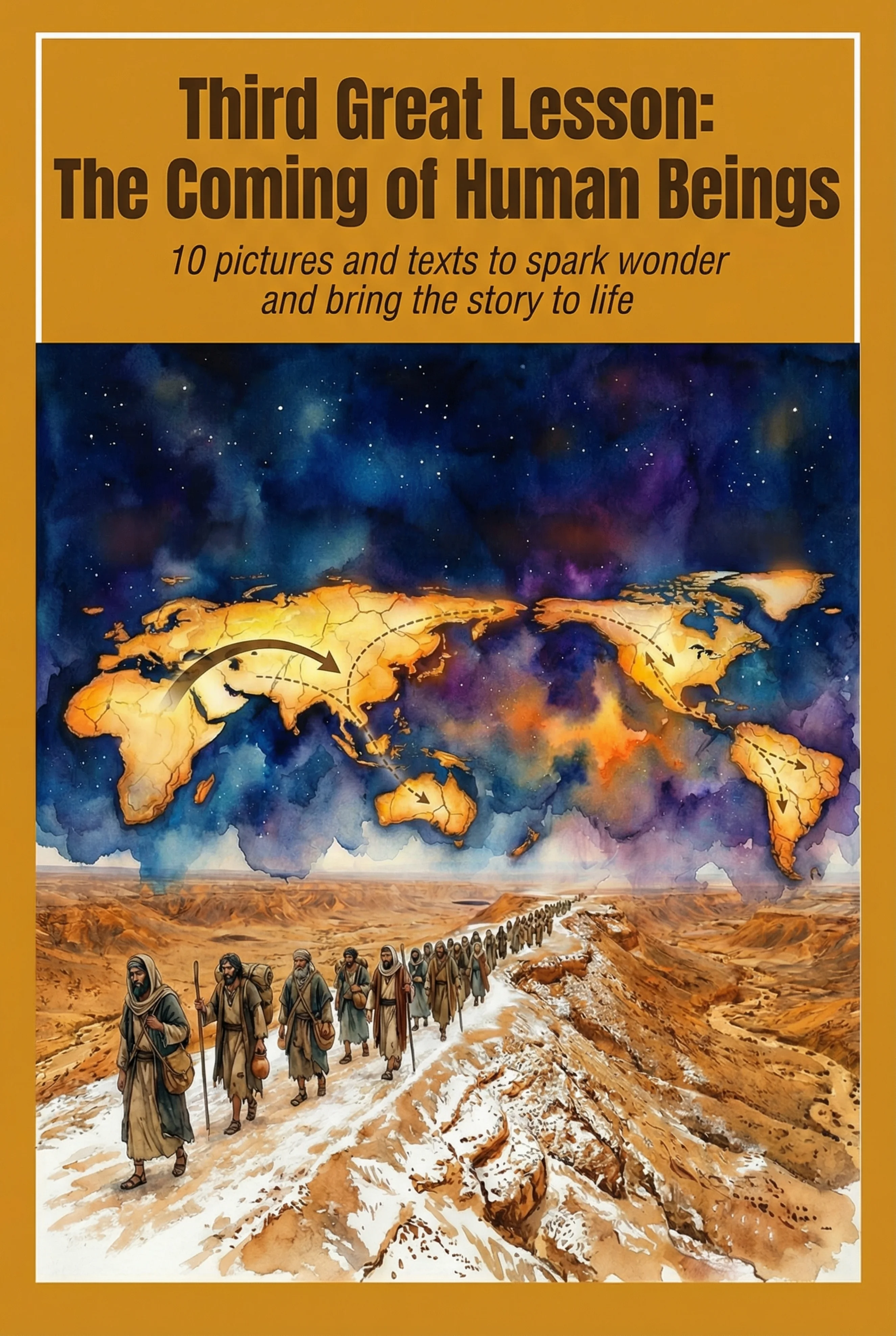
Imagine a moment when children's eyes light up with wonder—not because they're memorizing facts, but because they understand they are part of an ancient, magnificent story. The Third Great Lesson, The Coming of Human Beings, is precisely this magical turning point in Maria Montessori's Cosmic Education.
While the first two Great Lessons guided us through the birth of the universe and the emergence of life, the third lesson now turns our gaze inward—toward ourselves, toward humanity. Here begins a fascinating journey that reaches far beyond biological facts. It is the moment when Cosmic Education becomes a profoundly moral and social formation.
The transition of the human being from early childhood into the elementary years, typically occurring around the age of six, represents one of the most profound psychological metamorphoses in human development. Maria Montessori characterized this shift not merely as a continuation of growth but as a "rebirth" into a new plane of existence—distinct in its intellectual capabilities, social orientations, and moral sensitivities.
The child of the first plane (ages 0–6) possesses an "absorbent mind," soaking up the environment indiscriminately and unconsciously to form the self. In stark contrast, the child of the second plane (ages 6–12) is driven by a conscious, reasoning mind—a voracious intellect that seeks to understand the underlying causes, mechanisms, and interdependencies of the universe. It is for this specific psychological landscape that the framework of Cosmic Education was developed.
The Philosophical Core: The Third Great Lesson conveys far more than historical knowledge to children. It provides orientation, awakens wonder, and instills a deep sense of their place in the grand scheme. It answers not only the question "Where do we come from?" but poses the far more important question: "What is our task as humanity?"
The Third Great Lesson follows the same pedagogical principle as its predecessors: it works with the impressionistic method. Like an impressionist painting that doesn't show every detail but conveys an overall impression and mood, this lesson aims to leave lasting impressions. It seeks to awaken awe and wonder and ignite the child's natural curiosity—so that they will want to explore the details independently.
Cosmic Education is not simply a syllabus of disconnected subjects; it is a pedagogical philosophy that posits the universe as a unified, orderly whole in which every element—living and non-living—has a specific function or "cosmic task" to fulfill. To introduce this grandeur to the child, Montessori proposed the use of Great Stories or Great Lessons—five dramatic, impressionistic narratives presented at the beginning of each school year.
Situated centrally within the sequence of the five lessons, The Coming of Human Beings acts as the bridge between the physical and biological history of the Earth (covered in the First and Second Great Stories) and the history of human culture and invention (covered in the Fourth and Fifth Stories). This lesson is arguably the most critical for the child's self-construction, as it introduces the specific identity of the human species.
The lesson is experienced with all senses: images, charts, tangible objects, and a dramatic presentation weave biology, history, and geography into a coherent story. This multisensory presentation leaves a lasting impression and creates an emotional connection to the subject—a foundation upon which later detailed learning can build.
Particularly significant is this lesson for elementary children aged six to twelve. In this second plane of development, children develop a strong sense of justice, fairness, and morality. They begin to look beyond their own existence and ask: Who am I in this vast world? How am I connected to other people?
The Third Great Lesson provides an answer that is both comforting and inspiring: it shows that all humans at all times share the same fundamental needs. This recognition of a shared human history and collective responsibility is the pedagogical instrument for actively fostering tolerance, respect, and empathy.
It answers the elementary child's burgeoning existential questions: "Who am I?" "Where do I come from?" and "What is my task in this universe?" In the following sections, we will explore the individual elements of this fascinating lesson: the story itself, the three special "gifts" of humanity, the materials for illustration, the fundamental human needs, and—importantly—how we can convey this traditional narrative today in a scientifically accurate and ethically responsible way.
I. The Narrative: Content, Structure, and Methodology
The delivery of the Third Great Story is an act of storytelling that transcends a mere lecture. It is designed to be an "impressionistic" experience, engaging the child's emotions and imagination to cultivate a lasting sense of wonder and gratitude toward the human ancestors.
A. Preamble and Contextualization
The narrative typically begins by anchoring the child's mind in the context established by the previous lessons. The teacher recalls the First Great Lesson ("The Coming of the Universe"), reminding students of the formation of the Earth, the cooling of the crust, and the chaotic interplay of the elements. This is followed by a recapitulation of the Second Great Lesson ("The Coming of Life"), which detailed the procession of biological life from the Paleozoic era through the Mesozoic and Cenozoic eras.
The storyteller emphasizes a crucial limitation inherent in the animal kingdom: distinct biological specialization. The narrative describes how other creatures are bound by their instincts and physical forms—birds are born knowing how to build specific nests, fish are engineered to swim, and herbivores are compelled to eat plants. They are perfect in their adaptation but limited in their freedom.
This constraint sets the dramatic stage for the arrival of a new kind of being—one who is not specialized, one who is physically vulnerable, yet possessed of a mysterious power to adapt to any environment.
B. The Arrival and the Three Special Gifts
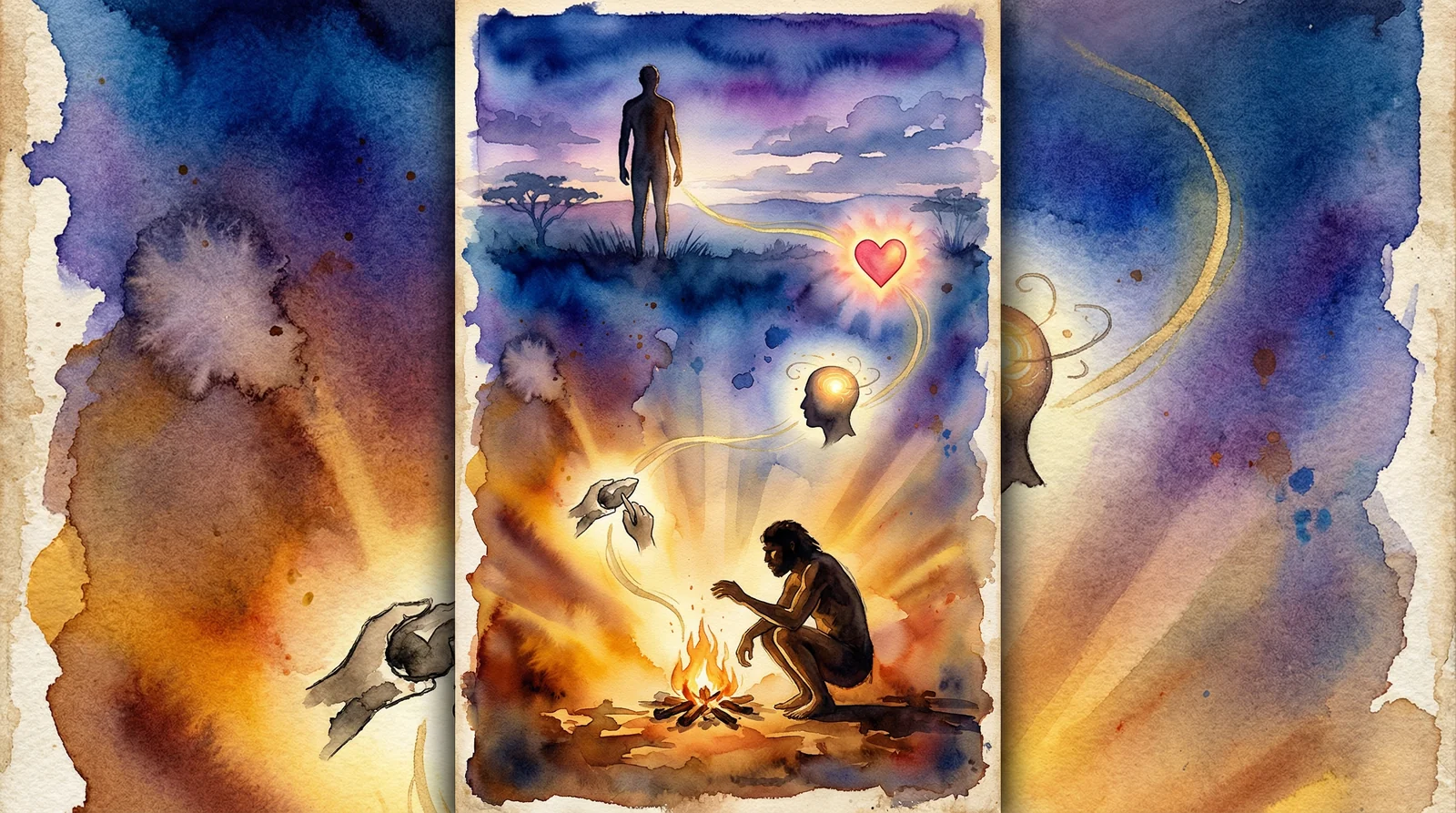
The climax of the story is the appearance of human beings at the very end of the geological timeline. Unlike the animals, who bring physical tools attached to their bodies (claws, fur, fangs), the human being arrives "empty-handed" but endowed with Three Special Gifts. These gifts constitute the central anthropological thesis of the lesson and are revisited throughout the elementary years.
1. The Gift of the Mind
The human mind is presented not merely as a processing unit but as a vessel for imagination and reason. The narrative explains that while animals can perceive what exists, the human mind can imagine what does not yet exist. This capacity for abstraction allows humans to solve problems, foresee the future, and invent technologies to overcome their physical limitations.
The child learns that our ancestors could look at a stone and envision a tool. They could observe the seasons and imagine storing food for winter. This gift of foresight and creative thinking sets humanity apart from all other creatures.
2. The Gift of the Hand
Montessori places immense emphasis on the hand as the "instrument of the intelligence." The story highlights the opposable thumb, a biomechanical marvel that allows for the "precision grip" necessary to fashion tools, create art, and manipulate the environment.
The narrative explicitly connects the freedom of the hand (achieved through bipedalism) with the development of the brain, reflecting a feedback loop of evolutionary progress. The hand is described as the tool that creates all other tools—from the first stone blade to the spacecraft that carry us to the stars.
This gift is not merely physical but represents the bridge between thought and action. Every building, every painting, every written word exists because of this remarkable gift.
3. The Gift of the Heart
The third gift is the capacity for a specific type of love—love that extends beyond the immediate biological family or pack to encompass humanity as a whole. The story illustrates this by describing how early humans cared for the sick, the elderly, and the deceased, behaviors not typically seen in the animal kingdom.
This gift is linked to the concept of social solidarity, enabling humans to cooperate in large groups and work for the benefit of future generations they will never meet. Archaeological evidence of healed bones and careful burials demonstrates that our ancestors cared for those who could not contribute to survival—a profound expression of the gift of the heart.
The child understands that this capacity for compassion and care for strangers is what allowed humans to build communities, share knowledge, and create civilizations.
C. Modern Addition: The Gift of Speech
In recent years, particularly within "reimagined" or modernized Montessori narratives, a fourth gift—the Gift of Speech—is often elevated to equal status. While traditional AMI scripts implicitly include language within the faculties of the Mind or as a result of the Hand/Mind interaction, newer AMS and progressive interpretations explicitly separate it to highlight its role in cultural transmission.
Speech is presented as the mechanism that allows the "Three Gifts" to be shared and accumulated across time, preventing each generation from having to reinvent the wheel. Through language, humans can:
Share experiences across distance and time
Preserve knowledge for future generations
Coordinate complex activities among large groups
Express abstract concepts like justice, beauty, and truth
The Unity of the Gifts: Together, these gifts form an integrated whole. The Mind imagines what could be, the Hand brings it into reality, the Heart motivates us to share it with others, and Speech allows us to pass it down through generations. No single gift would be sufficient without the others—it is their combination that makes humanity unique in the cosmic story.
The narrative structure is designed not to deliver facts but to evoke profound emotions: wonder at human potential, gratitude toward ancestors, and a sense of responsibility toward future generations. Each child who hears this story is invited to see themselves as inheritors of these gifts and stewards of human civilization.
II. Narrative Variations: AMI vs. AMS Traditions
The execution of the Third Great Story varies significantly between the Association Montessori Internationale (AMI) and the American Montessori Society (AMS) traditions, as well as among individual teacher training centers. Understanding these differences helps educators choose an approach that best serves their students while remaining true to the story's essential purpose.
A. The AMI Tradition
Classical Approach
The AMI approach, maintaining fidelity to the original lectures of Maria and Mario Montessori, tends to utilize a more formal, standardized script that is deeply philosophical. The visuals are often abstract or impressionistic—such as the "Hand Chart" or the "Long Black Strip"—rather than realistic illustrations of daily life.
- Standardized scripts: Teachers are trained to deliver the story with specific language, ensuring consistency across classrooms worldwide
- Abstract visuals: Materials focus on symbolic representation rather than realistic depiction
- Philosophical emphasis: The narrative centers on the universality of the human being as a cosmic agent
- Impressionistic approach: Details of daily prehistoric life are left for the child to discover through follow-up work
Critics within the community sometimes note that traditional AMI timelines, which may feature sparse illustrations of early humans, can feel disconnected from the child's emotional reality. However, proponents argue that this abstraction leaves more room for the child's imagination and subsequent research.
B. The AMS and Modern Traditions
Adaptive Approach
AMS-aligned programs and modern curriculum designers often adapt the story to be more culturally inclusive and scientifically detailed. These versions embrace the spirit of Montessori's work while updating it for contemporary classrooms.
- Personalized narratives: Some versions replace the abstract "human" with a narrative about a specific prehistoric family to foster empathy and engagement
- Diverse perspectives: Greater attention to including creation stories and origin narratives from various cultures
- Realistic supplementary materials: Three-part cards of hominid species, books on diverse cultures, and hands-on artifacts
- Scientific integration: Explicit discussion of modern discoveries like the "Out of Africa" theory and specific tool industries
- Standards alignment: Projects and activities that connect with state social studies and science standards
The narrative in these settings is more likely to explicitly address modern scientific updates, which traditional albums might generalize. This approach helps bridge the gap between Montessori's original vision and contemporary scientific understanding.
C. Finding Balance
Both traditions share the same fundamental goals: to inspire wonder, develop a sense of human solidarity, and spark independent research. The choice between approaches often depends on:
The children's backgrounds: Some groups may benefit from more concrete representations, while others thrive with abstraction.
Cultural context: Schools serving diverse populations may prioritize inclusive narratives.
Teacher training: Educators naturally gravitate toward the approach in which they were trained.
Available materials: Practical considerations of what resources are accessible.
The Essential Core: Regardless of tradition, the story must accomplish its primary purpose—to help children understand that they are part of an unbroken chain of human achievement, inheritors of the Three Gifts, and stewards of our shared future. The specific words matter less than the wonder they inspire.
Many contemporary Montessori educators find value in drawing from both traditions—using the philosophical depth of the AMI approach while incorporating the inclusive updates and scientific accuracy emphasized in modern curricula. This synthesis honors Montessori's original vision while acknowledging that education must evolve with our understanding of both science and pedagogy.
What remains constant across all traditions is the transformative power of the story itself—the moment when a child realizes they are connected to every human who has ever lived, and to every human who will ever be born. That realization transcends methodology.
III. Scientific Accuracy: Original vs. Modern Paleoanthropology
When Maria Montessori and her son Mario developed the materials for the Third Great Story in the mid-20th century, the field of paleoanthropology was in its infancy compared to today. Consequently, there are significant discrepancies between the "original" Montessori timelines and contemporary scientific understanding. The modern Montessori educator is tasked with bridging this gap, using the original materials as impressionistic tools while supplementing them with accurate data.
A. The Shift from Linear to Branching Evolution
Mid-20th-century science often depicted human evolution as a linear "march of progress"—a single line leading from ape-like ancestors to Homo sapiens. Original Montessori timelines often reflect this "Tree of Life" model.
However, modern science has established the "Bush" theory or "braided stream" model, revealing a complex web of hominid species co-existing, interbreeding, and competing over millions of years. We now know that at various points in history, multiple human species walked the Earth simultaneously—Homo sapiens lived alongside Neanderthals, Denisovans, and possibly others.
To address this, modern classrooms often use updated timelines that include a wider array of species. The chart below compares the hominids traditionally emphasized with the broader spectrum found in updated Montessori materials:
| Hominid Species | Role in Montessori Narrative | Scientific Context & Updates |
|---|---|---|
| Ardipithecus kadabba / ramidus | Often the starting point in modern timelines | Represents the Miocene/Pliocene transition; evidence of early bipedalism in wooded environments, challenging the savanna hypothesis |
| Australopithecus afarensis | The archetype of the "early ancestor" (e.g., "Lucy") | Used to illustrate full development of bipedalism while retaining a small brain size, proving walking upright preceded brain expansion |
| Homo habilis | The "Handy Human" – central to the "Gift of the Hand" | Traditionally credited with the Oldowan tool industry; marks the beginning of the Paleolithic and intentional modification of the environment |
| Homo erectus | The traveler and fire-user | Critical for discussing migration out of Africa and the conquest of fire; updated narratives distinguish between African H. ergaster and Asian H. erectus to show diversity |
| Homo neanderthalensis | Evidence of the "Heart" and spiritual life | The discovery of Neanderthal burials with flowers or artifacts evidences the "Gift of the Heart" and the birth of spiritual awareness/religion |
| Homo sapiens | The culmination of the "Three Gifts" | Associated with the explosion of art (cave paintings), complex language, and the eventual development of agriculture |
B. Chronological Adjustments and the "Red Strip"
A major feature of the Montessori history materials is the distinction between "Prehistory" (the black strip) and "History" (the red strip). In traditional presentations, the red strip representing recorded history is often defined as the last 5,000 to 6,000 years.
However, modern research challenges this boundary. The emergence of symbolic thought and "recorded" meaning—through petroglyphs, cave art, and tally sticks—dates back much further, potentially 70,000 years (Blombos Cave) or even earlier. Furthermore, the total timeline of the human lineage has expanded. While older materials might suggest a shorter duration, contemporary timelines often span 7 to 8 million years to account for the divergence from the last common ancestor with chimpanzees.
Educators are encouraged to present the "Red Strip" not as a rigid scientific fact but as a symbol of the intensity of recent written communication compared to the vastness of oral tradition. This nuanced approach honors both the original pedagogical intent and scientific accuracy.
Pedagogical Wisdom: The teacher must be prepared to handle the delicate balance between the "impressionistic" nature of the charts and the specific facts children might know from dinosaur books or documentaries. The teacher should frame the charts as "stories" or "charts made by people" that might be updated, encouraging children to research the latest findings.
C. New Discoveries and the Story
Recent decades have brought remarkable discoveries that enrich the Third Great Story:
Denisovans: A previously unknown human species identified through DNA analysis, showing that our ancestors interbred with multiple human species.
Homo naledi: Discovered in South Africa in 2013, this species with a small brain appears to have practiced burial rituals, challenging assumptions about brain size and symbolic behavior.
Homo floresiensis: The "Hobbit" discovered in Indonesia, showing remarkable diversity in human evolution and the possibility of isolated populations developing unique characteristics.
Advanced tool use: Stone tools now dated to 3.3 million years ago—before the genus Homo—indicating that tool use may have begun with Australopithecines.
These discoveries don't contradict the essential message of the Third Great Story—they enrich it. They show that the story of humanity is even more wondrous, complex, and fascinating than earlier generations knew. Each new fossil, each new genetic analysis, adds another chapter to our shared human narrative.
The modern Montessori educator has the privilege of presenting a richer, more nuanced story than was possible in Montessori's time—while preserving the wonder and gratitude that remain the lesson's beating heart.
IV. Anthropological Dimensions: The Fundamental Needs of Humans
Following the narrative of the coming of humans, the curriculum expands into anthropology through the "Fundamental Needs of Humans" chart. This material is essential for helping the child understand that while human forms of living have changed dramatically over millennia, human nature remains constant. Every civilization, from the earliest hunter-gatherers to modern societies, has grappled with the same essential needs.
A. Material and Spiritual Needs
The chart is traditionally divided into two categories, reflecting Montessori's holistic view of the human being as a composite of body and spirit. This dual nature makes humans unique—we are animals with physical needs, yet we are also beings who seek meaning, beauty, and connection.
Material Needs
These are the biological requirements for survival—the needs that humans share, in some form, with other animals. Yet even in meeting these basic needs, humans demonstrate their unique gifts of creativity and cooperation.
Nourishment
Food and water—the fundamental fuel for life. From gathering and hunting to agriculture and global food systems, humans have developed increasingly complex ways to meet this need.
Shelter
Housing and protection from the elements. From caves and simple huts to skyscrapers, human shelter reflects both necessity and the drive to create comfortable, beautiful spaces.
Clothing
Protection for the body against weather and environment. Clothing also became a form of expression, identity, and social communication.
Defense
Safety from predators, natural threats, and conflict. This need led to tools, weapons, fortifications, and eventually to complex systems of law and governance.
Transportation
The need to move oneself and goods. From walking to ships, trains, cars, and spacecraft—the human drive to explore and connect has transformed the world.
Spiritual Needs
These distinctively human needs arise from the "Gift of the Mind" and "Gift of the Heart." They are what make us human in the fullest sense—beings who seek meaning, create beauty, and build communities of shared understanding.
Art
Expression through painting, sculpture, music, dance, and storytelling. The earliest cave paintings show that art is as old as humanity itself—a fundamental need, not a luxury.
Religion/Philosophy
The search for meaning and understanding of the cosmos. Every culture has developed ways to explain existence, grapple with mortality, and connect with something greater than the individual.
Self-Adornment (Vanitas)
The need to beautify oneself, reflecting self-awareness and the desire to express identity. Jewelry, decoration, and personal style appear in the earliest human societies.
Community/Culture
Legal systems, social structures, education, and shared traditions. Humans cannot thrive alone—we need connection, belonging, and the accumulated wisdom of our communities.
B. Variations in Classification
Interestingly, the classification of certain needs varies between chart versions. For example, "Defense" is sometimes categorized as a material need (protection from tigers and natural threats) and sometimes as a spiritual/social need (legal systems, justice, armies) depending on the era being studied.
Similarly, "Communication" can be seen as a material tool for survival (warning calls, hunting coordination) or a spiritual vehicle for culture (poetry, philosophy, the transmission of wisdom). These ambiguities are not errors but pedagogical opportunities for debate and critical thinking among elementary students.
When children discuss whether "defense" is material or spiritual, they are engaging in genuine philosophical inquiry. They begin to see that categories are human constructions, useful but never absolute—a valuable lesson in critical thinking.
C. The Human Tendencies
Underlying the Fundamental Needs are the Human Tendencies, a concept elaborated by Mario Montessori. These are the innate drives that compel humans to satisfy their needs. They include:
Exploration: The drive to discover new territories, ideas, and possibilities
Orientation: The need to understand one's place in space and in society
Order: The desire for structure, pattern, and predictability
Abstraction: The capacity to form concepts and work with ideas
Imagination: The ability to envision what does not yet exist
Manipulation (Work): The drive to shape the environment with our hands
Repetition: The need to practice and perfect skills
Exactness: The desire for precision and accuracy
Communication: The drive to share experiences and ideas with others
Connecting Across Time: By linking the "Story of Humans" to these tendencies, the teacher helps the child realize that the same drive that pushed Homo erectus to explore new continents is the same drive that pushes the child to explore their neighborhood or the internet. This creates a psycho-emotional bond between the child and the entirety of the human race.
When a child understands that their own curiosity, their desire for order, their love of creating things with their hands—all of these connect them to every human who has ever lived—they gain a profound sense of belonging. They are not isolated individuals but participants in the great human adventure that stretches back millions of years and forward into an unknown future.
V. Philosophical and Spiritual Dimensions: Supernature and the Cosmic Task
The Third Great Story is arguably the most "cosmic" of the lessons because it addresses the agency of the human being. In Montessori philosophy, humanity is not an accident but a "Cosmic Agent" with a specific task: to complete the work of creation.
A. The Concept of Supernature (Supra-nature)
Maria Montessori coined the term "Supernature" (or Supra-nature) to describe the environment created by human work. While animals adapt to nature, humans adapt nature to themselves. We do not merely live in the natural world; we live in a world of houses, roads, laws, internet networks, and agriculture—a "second nature" built upon the first.
"Man... is the builder of a supra-nature."
This concept is crucial for the elementary child, who is developing a moral sense. The lesson highlights that everything the child enjoys—the clothes on their back, the pencil in their hand, the warmth of the classroom, the books they read, the roads they travel—is a gift from the labor of countless ancestors who built this Supernature.
Look around any room and consider: the chair was designed by someone, built by someone, transported by someone. The light comes from electricity generated by someone, transmitted through wires laid by someone, switched by mechanisms invented by someone. Every object represents a chain of human effort stretching back through time.
This realization is intended to produce a profound sense of gratitude and indebtedness. The child understands that they have received an inheritance of incalculable value—not money, but the accumulated wisdom, work, and creativity of all who came before.
B. Interdependence and the Single Nation
The narrative culminates in the idea that humanity has evolved into a "single organism" or a "single nation." In the modern world, no individual is self-sufficient; we rely on the work of millions of others for our daily bread, technology, and safety.
Consider your breakfast: the coffee may have been grown in Brazil, the sugar in the Caribbean, the wheat for your toast in Canada, the butter from local farms. Thousands of people—farmers, truck drivers, factory workers, shopkeepers—participated in bringing it to your table. You cannot eat a single meal without being connected to a global network of human cooperation.
Montessori argued that while humanity has achieved physical unity through global commerce and communication, it suffers because it has not yet achieved spiritual unity. We have built a global Supernature, yet we remain divided by nationalism, prejudice, and misunderstanding. The implicit moral lesson of the Third Great Story is that the child's generation has the task of harmonizing this Supernature, ensuring that the immense power of human invention is used for construction rather than destruction.
The Cosmic Task: Each generation inherits the Supernature and bears responsibility for its stewardship. The child learns that they are not merely a consumer of civilization but a participant in its ongoing creation. Their choices, their work, their contributions will shape the world for those who come after.
C. Gratitude and the Great River
This philosophical framework gives the Third Great Story its profound emotional resonance. It is not merely a lesson about where humans came from but about what humans are for. The child who truly absorbs this story carries with them a sense of purpose that transcends individual success or failure.
They understand that their life is part of something much larger—a continuing story that began long before their birth and will continue long after their death. They are inheritors and stewards, receivers of gifts and givers to the future. This understanding can shape an entire life, providing meaning in times of confusion and motivation in times of difficulty.
In an era of global fragmentation and environmental crisis, this lesson's emphasis on universal human solidarity, the oneness of the human species, and our shared responsibility for the Supernature we have built is perhaps more relevant and necessary than ever before.
VI. Curriculum Branches: The Explosion into Culture
The Third Great Story acts as a detonator for the entire cultural curriculum. It does not aim to teach all of history but to generate enough interest that the child will want to study it independently. Like a spark that ignites a fire, the story creates the desire to learn—and from that desire flows a lifetime of exploration.
A. History: The Conquest of Time
Understanding Time
The story introduces the intellectual tools for organizing time. Children learn to think historically—to understand that the present moment is the product of countless moments that came before, and that their actions will shape moments yet to come.
- Linear Time: The concept that time moves in one direction, marked by unique, unrepeatable events
- Timelines: The child moves from the "Long Black Strip" (Earth history) to the "Timeline of Human Beings" (anthropological history) to specific "Civilization Timelines" (cultural history)
- BC/AD (BCE/CE): The lesson provides the framework for understanding calendar systems and the dating conventions used by historians
- Historical Thinking: Cause and effect, change over time, multiple perspectives on the same events
From this foundation, children may pursue deep studies of specific civilizations—Ancient Egypt, Rome, the Maya, the Song Dynasty, the Inca—or trace themes across cultures: how different peoples met the need for shelter, how writing developed independently in different places, how religions spread and changed.
B. Geography: Migration and Adaptation
The Human Relationship with Earth
The study of early humans is inseparable from geography. Children discover that human history is shaped by rivers and mountains, climate and resources. They learn that we are not separate from the Earth but deeply embedded in its systems.
- Climate and Migration: How Ice Ages forced human migration and shaped population patterns
- Flora and Fauna: How the availability of plants and animals dictated settlement patterns and ways of life
- Physical Geography: How mountains, rivers, deserts, and oceans shaped the development of early civilizations
- Economic Geography: How different regions produce different resources and how trade connects distant peoples
This leads naturally to the study of modern geography—political boundaries, climate zones, economic systems—always with the understanding that geography is not merely about maps but about how humans live in relationship with the Earth.
C. Technology and Invention
The Gift of the Hand in Action
The "Gift of the Hand" leads directly to the study of technology. Children explore the progression of tool industries not just as rocks, but as evidence of rising intelligence and creativity—each improvement representing a breakthrough in human thinking.
- Stone Tool Industries: Oldowan, Acheulean, Mousterian—the progression of sophistication over millions of years
- The Conquest of Fire: How controlling fire transformed human life—cooking, warmth, protection, and community
- The Invention of the Wheel: A seemingly simple idea that revolutionized transportation and trade
- Domestication: How humans learned to work with plants and animals, transforming from hunter-gatherers to farmers
- The Agricultural Revolution: The birth of settled communities, surplus production, and complex societies
D. Social Studies and Anthropology
The Fundamental Needs chart becomes a powerful research tool. Children can analyze any culture—ancient or modern, familiar or foreign—by asking the same questions: How did they meet their need for shelter? For food? For transportation? For art? For community?
This framework promotes genuine cross-cultural understanding. The child discovers that the Inuit and the Bedouin, though living in opposite environments, grappled with the same fundamental needs—and that both found brilliant, creative solutions suited to their circumstances. Difference becomes a source of admiration rather than suspicion.
The Power of Questions: The Third Great Story teaches children to ask the right questions. Armed with the framework of fundamental needs and the three gifts, a child can approach any civilization, any historical period, any culture, and begin to understand it. They become not passive receivers of information but active investigators of the human story.
Each branch of study that grows from the Third Great Story connects back to its central insights: that humans are unique in their gifts, united in their needs, and responsible for the Supernature they continue to create. Whether studying ancient Rome or modern technology, the child maintains this cosmic perspective—seeing each development as part of the great human adventure.
VII. Practical Implementation: Teacher Preparation and Materials
The success of the Third Great Story relies heavily on the "Prepared Environment" and the teacher's capacity to be a storyteller. Unlike a textbook lesson that can be read aloud, this story requires the teacher to embody the wonder and gratitude they wish to transmit. The materials serve as touchstones, visual anchors for the imagination.
A. Essential Materials and Their Specifications
| Material | Physical Description | Purpose & Symbolism |
|---|---|---|
| The Long Black Strip | A 30-meter (approx. 100 ft) strip of black fabric. Originally 300 meters in India. | Represents the age of the Earth. A tiny 1-2 cm white/red strip at the end represents human time. It offers a sensory impression of humility and the brevity of human existence. |
| The Hand Chart | A 10-foot black canvas/cloth. Features a central image of a human hand holding a stone tool (or empty). | Represents the era of humans before writing. A thin red strip (approx. 1/2 inch) at the end represents recorded history. Symbols often include "bubbles" representing consciousness or imagination. |
| First Timeline of Humans | A chart showing the biological evolution of hominids (e.g., Australopithecus to H. sapiens) and lithic industries. | Visualizes the "bush" of evolution. Focuses on physical changes and simple tools. Often mute/control sets are used for student work. |
| Second Timeline of Humans | Shows the progression of human activity: Glaciations, Paleolithic phases (Lower, Middle, Upper), Neolithic revolution, Bronze/Iron Ages. | Focuses on cultural evolution and the satisfaction of needs. Links prehistory to the first civilizations (Sumer, Egypt). |
| Fundamental Needs Chart | A matrix layout showing Material vs. Spiritual needs. Variations exist in illustrations (modern vs. ancient). | A research tool. Allows children to analyze any culture by asking: "How did they meet their need for shelter? For art? For defense?" |
B. Teacher Preparation
Internalization of the Story
The teacher must internalize the story. Reading from a script is discouraged; the guide should maintain eye contact and use voice modulation to convey mystery and excitement. The story should feel like a gift being shared, not a lesson being delivered.
- Memorization: Key phrases like "The God with no hands" (in religious variations) or specific scientific descriptions of the "Three Gifts" should be memorized for impact
- Personal Connection: The teacher should feel genuine wonder at the story—children sense authenticity
- Flexibility: While maintaining the essential narrative, the teacher should be ready to adapt to the group's energy and questions
Environment Setup
The lesson is often given on the floor with a large rug, creating an intimate gathering rather than a classroom lecture. The physical arrangement signals that something special is about to happen.
- Space Requirements: The unrolling of the "Long Black Strip" requires significant physical space (often a hallway or outdoors)
- Lighting: Some teachers dim the lights or use candles to create atmosphere
- Materials Ready: All charts and materials should be prepared and positioned for dramatic reveal
- Minimal Distractions: The environment should support focused attention and imagination
Handling Scientific Questions
The teacher must be prepared to handle the delicate balance between the "impressionistic" nature of the charts and the specific facts children might know from dinosaur books or documentaries.
- Frame Charts as Stories: Present materials as "charts made by people" that might be updated, encouraging children to research the latest findings
- Embrace Questions: When a child asks "Is that really what they looked like?" use it as an opportunity to discuss how scientists learn about the past
- Model Curiosity: Respond to challenging questions with genuine interest: "That's a great question—let's find out together"
- Control of Error: Provide research materials so children can verify and extend their understanding
C. "Going Out" and Follow-Up
A unique feature of the Montessori elementary program is "Going Out." The Third Great Story is designed to provoke questions the classroom cannot answer. Teachers must be prepared to facilitate small group excursions—planned by the children—to museums, libraries, or universities to find answers about specific hominids or ancient tools.
In the classroom, follow-up work might include:
Creating personal timelines: A "Clock of Eras" or personal timeline that helps the child visualize deep time
Building models: Constructing shelters from different biomes using natural materials
Imaginative writing: Stories from the perspective of an early human ("A Day in the Life of Homo erectus")
Tool-making: Supervised experiments in creating stone tools or other primitive technologies
Art projects: Cave painting recreations, clay figurines, or other prehistoric art forms
Research projects: Deep dives into specific civilizations, hominid species, or technological developments
The Teacher as Guide: The teacher's role shifts after the story is told. No longer the center of attention, the teacher becomes a resource, a facilitator, a fellow explorer. The story has done its work—it has ignited curiosity. Now the teacher supports the child's own investigation, offering materials, suggesting resources, and celebrating discoveries.
This transition from storyteller to guide reflects Montessori's fundamental insight: education is not about transferring information from teacher to student but about awakening the child's own desire to learn. The Third Great Story, properly told, creates that awakening—and the teacher's subsequent role is to nurture the fire that has been lit.
Conclusion: The Enduring Relevance
The "Coming of Human Beings" is more than a history lesson; it is an orientation to the human condition. By weaving together the scientific story of evolution with the philosophical story of the "Three Gifts" and "Supernature," the Montessori curriculum offers the child a dignified and purposeful identity.
The child learns that they are not a random accident of biology, but a being possessing the Mind, Hand, and Heart necessary to continue the work of creation. They inherit an unbroken chain of human achievement stretching back millions of years, and they bear responsibility for passing on this inheritance—enriched, if possible—to those who will come after.
Contemporary Relevance
In an era of global fragmentation and environmental crisis, this lesson's emphasis on universal human solidarity, the oneness of the human species, and our shared responsibility for the Supernature we have built is perhaps more relevant and necessary than ever before.
Today's children face unprecedented challenges: climate change, biodiversity loss, social polarization, technological disruption. They need more than facts and skills to navigate these challenges—they need a sense of who they are and why their choices matter. The Third Great Story provides this foundation.
When a child understands that they belong to a single human family, that every culture has grappled with the same fundamental needs, that the Supernature we live in was built by countless hands working across generations—they develop the perspective needed to act wisely in a complex world.
"The child who has felt a strong love for his surroundings and for all living creatures, who has discovered joy and enthusiasm in work, gives us reason to hope that humanity can develop in a new direction."
The Invitation
Through this Great Story, the child is invited to take their place in the "Great River" of humanity, ready to contribute their own gift to the future. This is not a burden placed upon them but an honor—the recognition that they matter, that their choices will shape the world, that they are needed.
The story does not tell children what to do with their gifts; it awakens them to the fact that they have gifts. It does not prescribe the solutions to humanity's problems; it inspires the desire to be part of the solution. It does not provide answers; it generates questions that can fuel a lifetime of learning and service.
A Foundation for Life: Children who receive this story well—who truly internalize its message of human unity, gratitude for inheritance, and responsibility to the future—carry with them a philosophical foundation that can guide them through all of life's challenges. They know who they are: cosmic agents, inheritors of the three gifts, stewards of the Supernature.
The Third Great Story is ultimately about hope. It shows that humans, for all our flaws, have accomplished remarkable things—and that we have the capacity to accomplish more. It shows that we are not alone, but connected to every person who has ever lived and every person who will ever be born. It shows that our lives have meaning not despite our mortality but because of it—because we are part of something larger than ourselves.
For Montessori educators, telling this story is a profound privilege. We hold in our hands the opportunity to shape how a child understands their place in the universe. We can give them a story that fills them with wonder, gratitude, and purpose—a story they will carry with them always, a light to guide them through whatever challenges they may face.
The Story Continues
And the story is not over. Each child who hears it becomes part of it. Their discoveries, their creations, their acts of kindness and courage—all add new chapters to the great human adventure. The Coming of Human Beings is not just about where we came from. It is about where we are going, together.