The Cosmic Vision Unveiled
Imagine showing a child that everything they will ever learn—from the birth of stars to the invention of writing, from the first stirrings of life to the development of mathematics—is one magnificent, interconnected story. This is Cosmic Education: Maria Montessori's boldest and most sophisticated vision, offering children aged six to twelve the entire universe as their classroom.
Developed primarily during her years of wartime exile in India (1939–1946), Cosmic Education emerged from Montessori's profound recognition that elementary-age children possess something extraordinary: a newly awakened reasoning mind, a capacity for imagination that transcends immediate experience, and a burgeoning moral consciousness that demands answers to the deepest existential questions. The Five Great Stories—dramatic narratives spanning the creation of the universe through the development of human culture—serve not as curriculum content to be memorized but as seeds planted in fertile imaginative ground, from which all subsequent learning grows organically.
What Makes Cosmic Education Unique: Unlike conventional integrated curricula or environmental education, Cosmic Education carries a teleological dimension—the conviction that every element in the universe, from subatomic particles to human beings, fulfills a "cosmic task" contributing to the whole. This philosophy transforms learning from mere information acquisition into existential orientation, helping children discover their place within the cosmic narrative and their responsibility to contribute meaningfully to human civilization.
The Philosophical Roots of "Cosmic"
Maria Montessori chose the term "cosmic" with deliberate precision. The word derives from the Greek kosmos (κόσμος), meaning "order" or "arrangement"—the antonym of chaos. When Pythagoras first applied this term to the universe, he conceptualized it as reflecting divine mathematical harmony, an ordered system with interconnected parts serving the whole. Montessori drew on this rich philosophical lineage to articulate an educational vision grounded in order, purpose, and interconnection.
"Since it has been seen to be necessary to give so much to the child, let us give him a vision of the whole universe. The universe is an imposing reality, and an answer to all questions... all things are part of the universe, and are connected with each other to form one whole unity."
— Maria Montessori, To Educate the Human Potential (1948)
This statement encapsulates the essence of Cosmic Education—not merely teaching about the universe, but presenting it as an organizing framework that satisfies the child's deepest psychological and intellectual needs. Camillo Grazzini, speaking at the 24th International Montessori Congress in 2001, defined this vision as "an indivisible unity made up of energy, of sky, of rocks, of water, of life, of humans as adults and humans as children that lends a sense of the cosmic to Montessori's thinking."
Distinguishing Cosmic Education from Related Approaches
Cosmic Education must be carefully distinguished from superficially similar educational philosophies. Understanding these distinctions reveals what makes Montessori's approach so distinctive:
Environmental Education
Focuses specifically on ecological systems and human-nature relationships. Cosmic Education encompasses these themes but embeds them within a framework spanning the entire universe, human civilization, and moral-spiritual development.
Holistic Education
Emphasizes educating the "whole child" across multiple dimensions. Cosmic Education adds distinctive elements: specific developmental alignment with ages six to twelve, the concept of "cosmic task," and explicit connection to Montessori's planes of development theory.
Integrated Curriculum
Conventional approaches connect subjects thematically around topics or projects. Cosmic Education begins with the whole universe and moves to parts—a whole-to-part methodology rather than part-to-whole. Its philosophical grounding is existential: helping children find their place and purpose.
Perhaps most importantly, the narrative framework of the Five Great Stories provides a grand arc from creation to present that no thematic unit can replicate. The stories function as cognitive organizers, giving every subsequent piece of learning a home within a magnificent story.
The Cosmic Plan and Cosmic Task
Central to Montessori's philosophy is the "cosmic plan"—the underlying order and purpose animating the universe. She wrote: "The secret of success is found to lie in the right use of imagination in awakening interest, and the stimulation of seeds of interest already sown by attractive literary and pictorial material, but all correlated to a central idea, of greatly ennobling inspiration—the Cosmic Plan in which all, consciously or unconsciously, serve the Great Purpose of Life."
The complementary concept of "cosmic task" proposes that every entity—living and non-living—contributes to the greater whole, often unconsciously. Montessori observed that "all creatures work consciously for themselves, but the real purpose of their existence remains unconscious, yet claiming obedience."
Wonder in Action: Consider how early shellfish filtered calcium from water, creating limestone that would become the building blocks of future civilizations. First land plants produced oxygen, enabling animal life to flourish. Even fossil fuels represent decayed organisms serving future generations. Through Cosmic Education, children come to understand themselves as participants in this ongoing cosmic work, eventually discovering their own unique contribution to the grand story of existence.
From Rome to India: The Historical Journey
Maria Montessori did not conceive Cosmic Education fully formed. Rather, it represents the maturation and culmination of her educational philosophy over four decades, reaching its definitive expression during her extraordinary years of wartime exile in India—a period that would transform both her thinking and the world of education forever.
The Foundation Years and Early Expansion
The story begins on January 6, 1907, when Montessori established her first Children's House (Casa dei Bambini) in Rome's San Lorenzo district. Initially focusing on children ages three to six, her early work centered on practical life skills, sensorial materials, and a remarkable discovery: children showed extraordinary capacity for concentration, independence, and joy when provided an appropriate environment.
As parents requested continuation of Montessori education beyond age six, she began developing elementary materials through the 1920s and early 1930s. The first formal articulation of what would become Cosmic Education occurred at the Fifth International Montessori Congress in Oxford, England, in 1935, where Montessori presented "further principles of Montessori education for Elementary."
Throughout the 1930s, her thinking was stimulated by debates among English scholars on the "cosmic plan," including contributions from evolutionary biologist Julian Huxley and theologian Pierre Teilhard de Chardin—a convergence of scientific and spiritual perspectives that would shape her developing vision. Simultaneously, Montessori became increasingly focused on peace education. In 1932, she spoke on "Peace and Education" at the Second International Montessori Congress in Nice, and in 1937, the Sixth International Congress was held on the theme "Education for Peace." She called for a "science of peace" and articulated education's role in reforming society—themes that would become inseparable from Cosmic Education.
The Transformative India Period (1939–1946)
The crystallization of Cosmic Education occurred during circumstances Montessori could never have anticipated. In October 1939, at age sixty-nine, she and her son Mario departed for India at the invitation of George Arundale, President of the Theosophical Society, intending a three-month visit to conduct teacher training. The invitation reflected existing Indian interest in her work—an Indian student had attended her first international course in Rome in 1913, the Montessori Society of India formed in 1926, and Rabindranath Tagore had established "Tagore-Montessori" schools by 1929.
A Twist of Fate: When Italy entered World War II in June 1940, both Montessoris were declared enemy aliens. Mario was interned at a British labor camp in Ahmednagar while Maria was confined to the Theosophical Society compound in Adyar, Madras (now Chennai). Separated from her son and interpreter, Montessori was "quite literally, struck dumb"—unable to communicate effectively beyond basics.
"We have long thought what to give you for your seventieth birthday. We thought the best present we could give you was to send you back your son."
— Telegram from the Viceroy of India, August 31, 1940
What began as involuntary confinement became an extraordinarily creative period. Maria and Mario spent significant time at the hill station of Kodaikanal, where the serene, nature-rich environment facilitated deep philosophical development. A student, Lena Wikramaratne, helped create an experimental school mixing European, American, and Indian children of various ages—a living laboratory for developing elementary curriculum.
The influence of Indian philosophy proved profound. The Kidken Montessori Foundation describes how "the concept was deeply influenced by the natural beauty of the Kodaikanal hills and, more importantly, by the core tenets of Indian philosophy, which revere the interdependence and interconnectedness of all life." Montessori observed diverse communities of Hindus, Muslims, Christians, and Buddhists living together at the Theosophical Society, reinforcing her belief in universal human spirit. Her exposure to Gandhian thought strengthened her ideas on peace education and non-violence.
Seven Years of Creation
During these seven years, Montessori conducted sixteen training courses in Madras, Kodaikanal, Karachi, Ahmedabad, and Ceylon, training over 1,500 teachers. Her publications from this period included The Child (1941), Reconstruction in Education (1942), and Education for a New World (1946).
The India Lectures
She delivered thirty lectures on early childhood development that would be collected as What You Should Know About Your Child (1949).
The Theosophical Connection
A historically significant discovery emerged after Montessori's death in 1952, when Theosophical Society President C. Jinarajadasa revealed that Montessori had joined the organization on May 23, 1899—before establishing her first Children's House. Her original application was found in the Society's archives.
While scholars debate the depth of Theosophical influence on her educational philosophy, the evidence suggests early and possibly significant exposure to ideas about cosmic unity and evolution that would later inform Cosmic Education. As Winifred Wylie observed in Quest Magazine, both Montessori and Annie Besant shared "common vision of the evolution and the oneness of life."
Key Texts of the Mature Period
The publications emerging from the India years constitute the definitive statements of Cosmic Education:
To Educate the Human Potential (1948)
The foundational text. Its opening chapter, "The Six-Year-Old Confronted with the Cosmic Plan," provides the philosophical statement of Cosmic Education while subsequent chapters offer natural history content supporting the Great Lessons. Montessori explicitly stated: "This plan of cosmic education as a foundation stone of the Advanced Method was first explained in England in 1935, and it has already proved itself to be the only path on which our feet can firmly tread in further educational research."
From Childhood to Adolescence (1948)
Extends cosmic principles through adolescence, describing the "Erdkinder" (children of the earth) and articulating how education should transform across developmental stages. Montessori wrote: "Here then is the essential principle of education: to teach details is to bring confusion; to establish the relationship between things is to bring knowledge."
The Absorbent Mind (1949)
Based on Indian lectures and published by the Theosophical Publishing House, this represents the culmination of her thinking on early childhood—the foundation upon which Cosmic Education builds.
The Psychological Foundation
Cosmic Education is not an arbitrary curricular choice but a precisely calibrated response to the psychological characteristics of children ages six to twelve—what Montessori termed the "second plane of development." Understanding why this approach works requires understanding the remarkable transformation that occurs in the child's mind around age six.
The Four Planes Framework
Montessori's developmental theory identifies four distinct planes spanning birth to age twenty-four, each with characteristic psychological qualities and educational needs:
The transition from first to second plane represents a "psychological rebirth." Montessori observed dramatic changes in how children relate to knowledge, their environment, and others.
The Reasoning Mind Emerges
The defining characteristic of the second plane is the shift from "absorbent mind" to "reasoning mind." In To Educate the Human Potential, Montessori explained: "Education between the ages of six to twelve is not a direct continuation of that which has gone before, though it is built upon that basis. Psychologically there is a decided change in personality, and we recognize that nature has made this a period for the acquisition of culture, just as the former was for the absorption of the environment."
The Critical Difference: Where the absorbent mind takes in what is without discrimination, the reasoning mind asks why and how. This fundamental shift in cognitive orientation is what makes Cosmic Education not just appropriate but necessary for this age group.
"Why are the fish dead? Why? Why do things happen? How do they come about?"
— Questions from six-to-twelve-year-olds, as recorded by Montessori in Citizen of the World
Montessori illustrated this vividly through an anecdote: When fish in a school aquarium died, the younger children (under six) excitedly announced the news to each newcomer, then returned to their activities. The older children stood quietly around the aquarium, asking the profound questions about causation and meaning. This questioning orientation creates what Montessori called the "sensitive period of culture"—an intense receptivity to systematic knowledge about the world. The child's mind has become, in her metaphor, "a fertile field in which seeds may be sown, to grow under the heat of flaming imagination."
Moral Imagination and Conscience Development
The second-plane child develops a nascent moral consciousness that distinguishes this period from early childhood. Montessori noted that "the child begins to become conscious of right and wrong, this not only as regards his own actions, but also the actions of others... moral consciousness is being formed and this leads later to the social sense."
Deep Concern with Justice
Children become intensely focused on fairness, constantly evaluating whether situations and outcomes are "just" or "unjust."
Interest in Social Rules
An intense fascination with the rules governing social groups emerges, as children work to understand the frameworks of community life.
Recognition of Injustice
Children begin to perceive social and economic injustices in the world around them, often with profound emotional responses.
Desire for Moral Action
A strong impulse to take action on moral issues develops—to right wrongs and contribute to the greater good.
What parents sometimes perceive as "tattling" actually reflects the child checking their understanding of rules against adult authority—an essential step in conscience formation.
Cosmic Imagination and Hero Worship
At age six, a new capacity emerges that Montessori termed "cosmic imagination"—the ability to use imagination to grasp concepts beyond immediate sensory experience. Children can now conceptualize deep time, distant places, historical periods, and abstract ideas. This capacity develops precisely because the sensorial foundation of the first plane has been established; imagination can now work with accumulated impressions to reconstruct realities that cannot be directly observed.
"Not only can imagination travel through infinite space, but also through infinite time; we can go backwards through the epochs, and have the vision of the earth as it was."
— Maria Montessori, To Educate the Human Potential
This imaginative power makes Cosmic Education possible; children before age six cannot meaningfully engage with concepts of deep time or cosmic evolution because they lack this psychological capacity.
The second-plane child also exhibits pronounced hero worship, becoming focused on admired figures—whether sporting personalities, historical characters, or older peers. This tendency serves identity formation as children think about how to actualize their own potential. The Great Lessons deliberately incorporate stories of "unknown heroes"—the first humans who discovered fire, created tools, painted cave walls—satisfying this developmental need while fostering gratitude for humanity's collective achievements.
Social Instincts and the Herd Impulse
The second plane marks a significant shift toward social orientation. Where the first-plane child focuses primarily on self and immediate environment, the six- to twelve-year-old exhibits what Montessori termed the "herd instinct"—a strong need to belong to groups and collaborate with peers. Children form "micro-societies" with their own rules, elect leaders, and practice different social roles.
Why This Matters for Cosmic Education: This social orientation has profound implications. Group research projects, collaborative presentations, and "going out" expeditions all satisfy developmental needs while building cooperation skills. The multi-age Montessori classroom (typically spanning three years) increases sociability range, ensuring children find peers who share their interests and skill levels.
The Five Great Stories: Seeds for the Imagination
The Five Great Stories—also called Great Lessons—constitute the pedagogical heart of Cosmic Education. They are not curriculum content to be memorized but "seeds" planted in the child's imagination, from which all subsequent learning grows. Each story opens vast domains of exploration, inviting children to investigate, question, and discover.
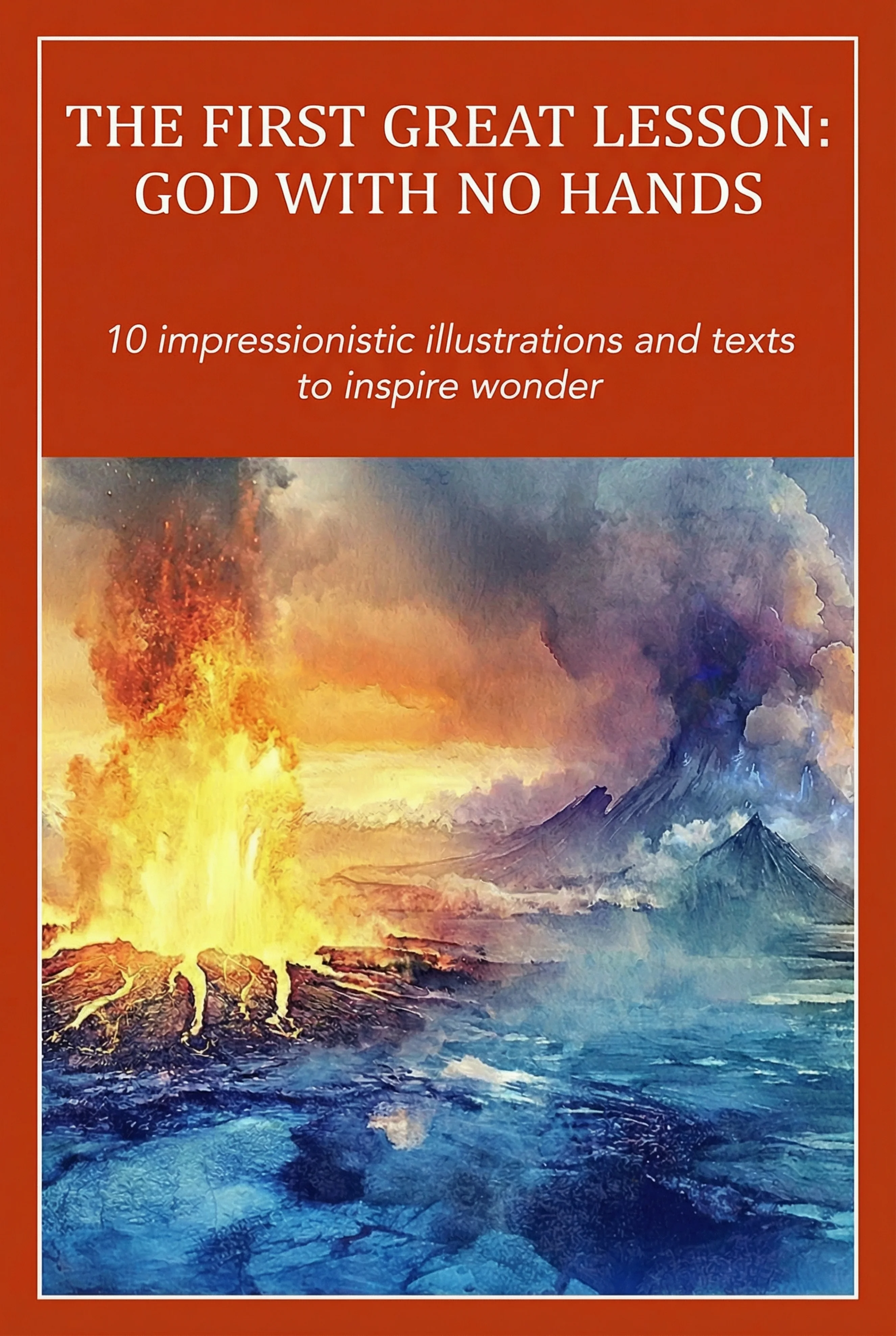
This story opens the school year by presenting the formation of the universe, solar system, and Earth. The narrative begins with reflection on how humans throughout time wondered about origins, then proceeds through key sequences: the primordial void of immeasurable darkness; the emergence of a vast fiery cloud containing all matter; the bestowal of laws upon every particle (personified through the phrase "I joyfully obey"); the breaking of the cloud into stars; Earth's formation and cooling; the volcanic period; and finally the establishment of oceans and atmosphere.
Mario Montessori explained that his mother gave the story its evocative title when presenting to Catholic children, creating a "God" character with no hands, eyes, ears, or mouth—one who creates through laws rather than direct action. This invites children to wonder "how this could be and to come up with their own theories."
The story employs sophisticated literary techniques: personification of elements having "loves" and "dislikes"; epic scale contrasts; numerical wonder (light traveling 297,600 kilometers per second); and the unifying refrain "I joyfully obey" establishing cosmic harmony through unconscious service. Six impressionistic experiments accompany the telling—demonstrations of states of matter, chemical affinity, liquid movement, different melting points, density layering, and volcanic activity—making abstract concepts tangible.
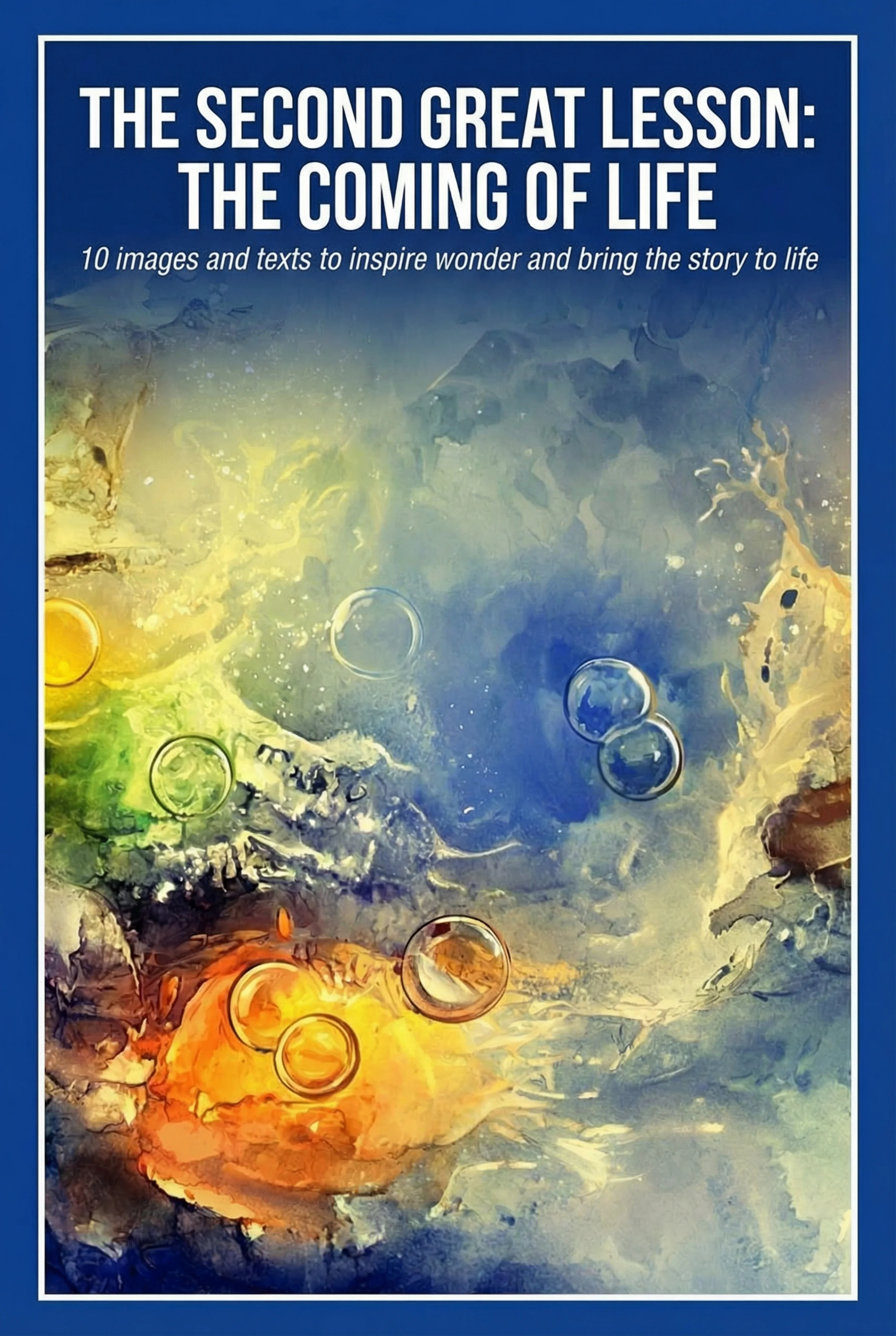
The Timeline of Life story begins by establishing a problem: rainwater eroding rocks has begun poisoning the seas with calcium carbonates. From this crisis emerges life itself—"little blobs of jelly, so little you can hardly see them but they could move, sense things and feel things." These single-celled organisms receive the law: "Eat, grow and make more of themselves."
The narrative traces life's progression through specialization of cells, shell formation (some organisms found the water "itchy" and made shells "like little jackets"), movement through geological eras showing trilobites, cephalopods, crinoids, first land plants, fish developing internal skeletons, amphibians gaining lungs and limbs ("There was the first voice when the frog croaked"), reptiles and dinosaurs, and finally mammals with warm blood, fur, and exceptional care of offspring.
The story culminates with humans: "Then it was the turn of a very special creature, who had no fur coat and no sharp teeth and not even any claws, but had three important gifts—a larger brain to think and imagine, an upright posture so she could use hands to make things, and a heart that can love even people he hadn't met."
The Timeline of Life material—approximately eight feet long, color-coded by era (blue for Paleozoic ocean life, brown for Mesozoic land life, green for Cenozoic)—serves as a reference children return to throughout their studies.
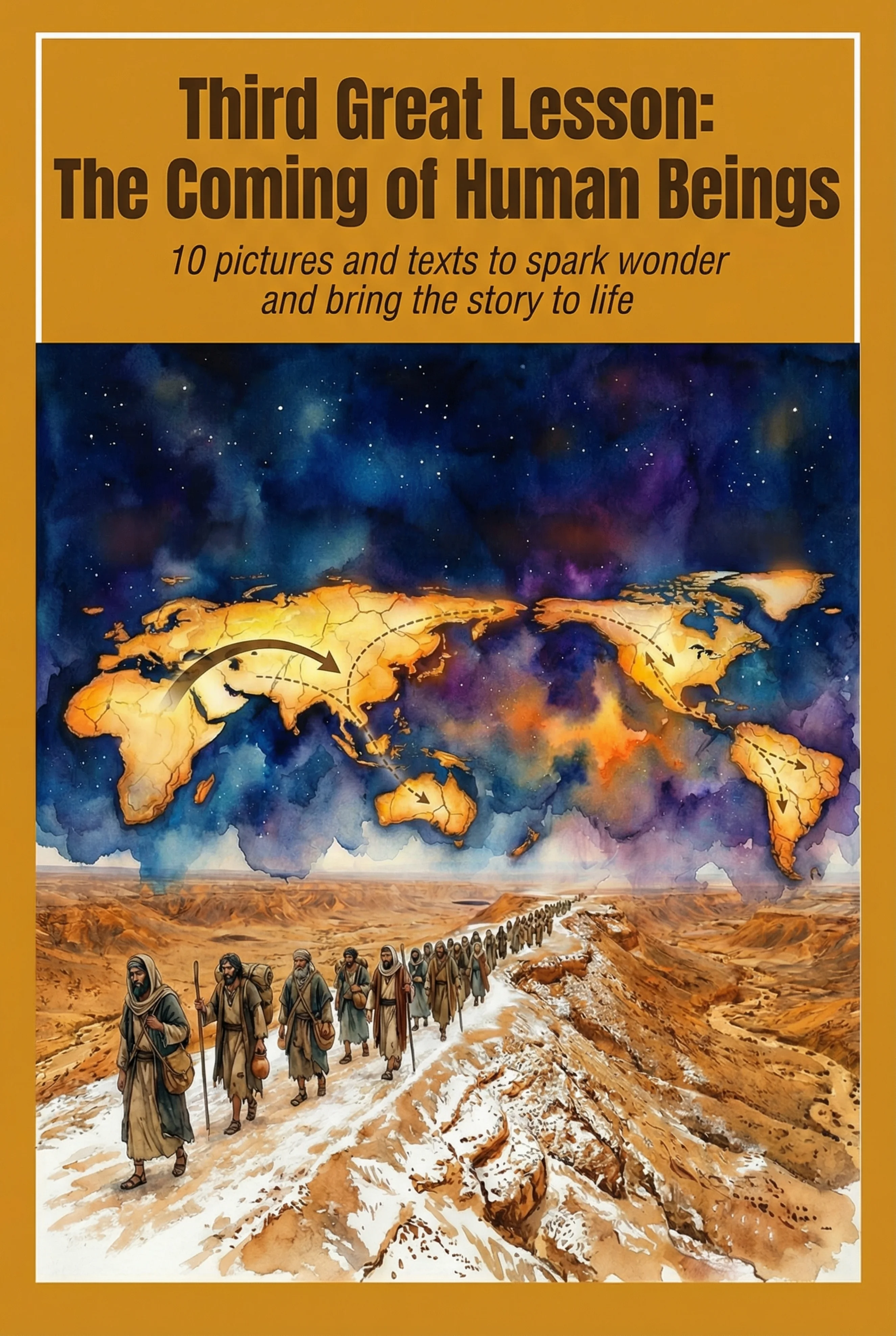
This lesson begins with discussion about what makes humans special, eliciting children's ideas about the mind, capacity to love, and ability to use hands. The presentation introduces "The Three Gifts": the mind that can think and wonder; the heart that can love even those far away; and the hands freed by upright posture.
The Hand Timeline—a three-meter black cloth strip with a tiny red strip representing written history and a hand holding a stone tool in the middle—visualizes humanity's vast preliterate existence. Teachers ask children to imagine what people were doing throughout this unmarked period: "They are looking for food. They are fishing. They are singing to their baby. They are playing tag."
This story opens the study of Fundamental Human Needs—Montessori's framework showing that all humans throughout history have had the same basic material needs (food, clothing, shelter, defense, transportation, communication, health) and spiritual needs (art, religion, self-adornment, community, love). Children study how different civilizations met these universal needs, developing empathy across cultures and understanding of common humanity.
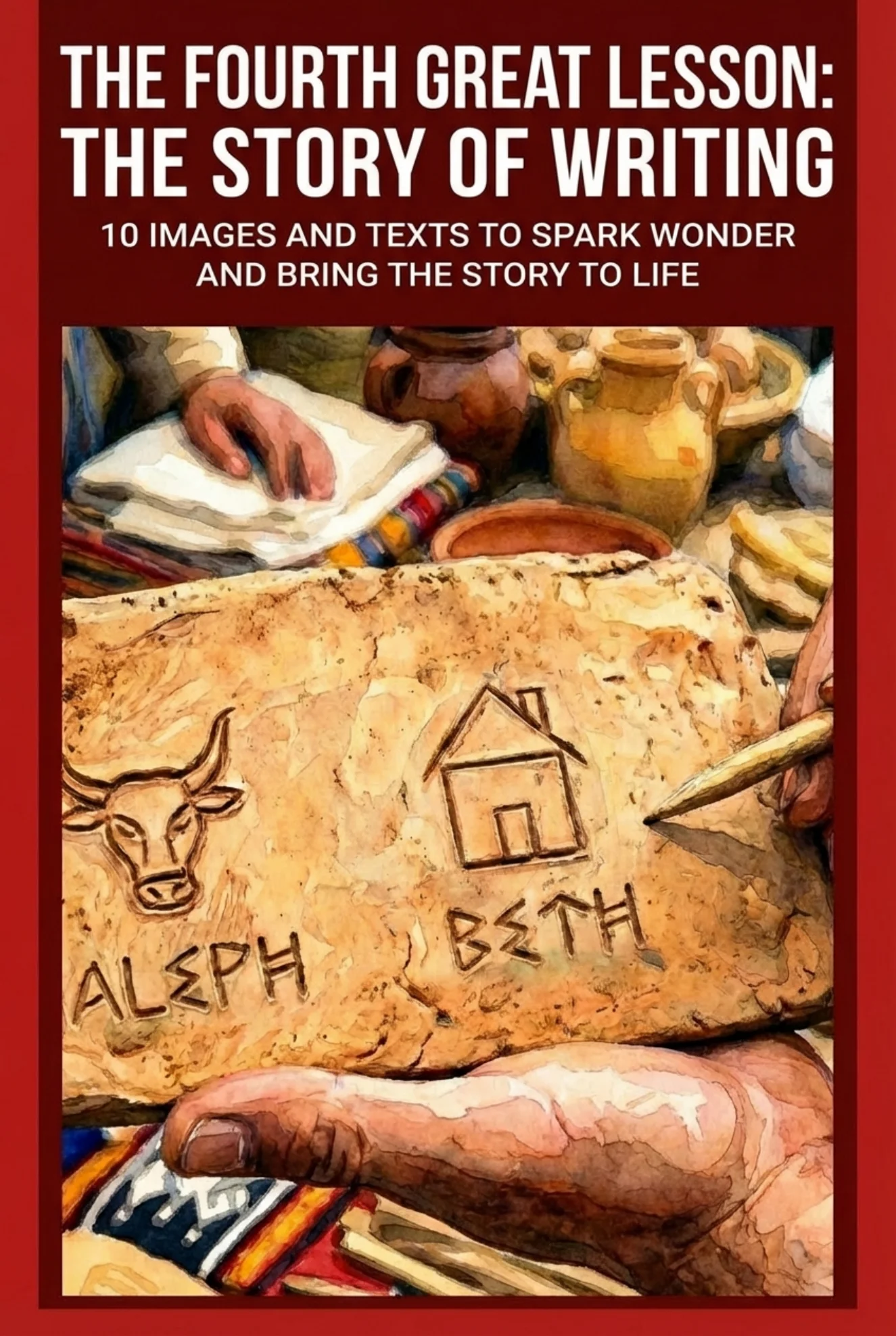
The Story of Communication in Signs traces humanity's journey from oral to written expression through several stages: cave paintings, pictographs, ideograms, hieroglyphics, cuneiform, the breakthrough Phoenician alphabet (symbols representing sounds rather than ideas), Greek additions of vowels, Roman alphabet, and the printing press.
The narrative emphasizes the human need to communicate—before writing, knowledge died with the knower; writing created permanence. Short vignettes illustrate communication challenges that drove invention, showing necessity as the mother of progress.
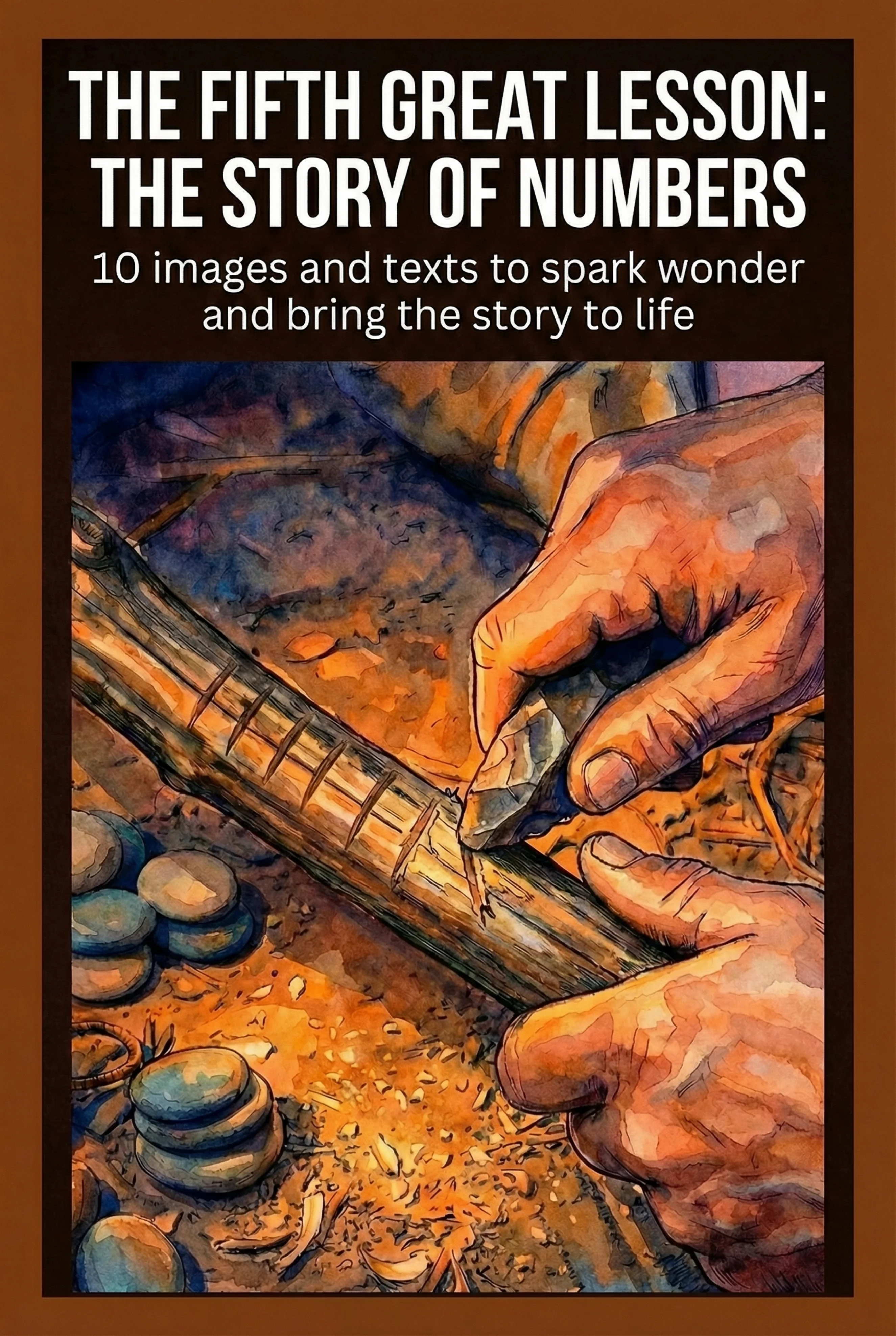
The Story of Our Numerals traces mathematical development from earliest counting systems—when humans had only "one," "two," and "more than two"—through body counting, tally marks, pebbles and tokens, Babylonian base-60 (explaining our sixty-second minute and sixty-minute hour), Egyptian numerals, Roman numerals, the revolutionary Indian-Arabic numerals with zero, and modern decimal and binary systems.
The narrative emphasizes how trade, agriculture, astronomy, and construction drove mathematical development—the human need for precision and measurement. Nine number charts showing different historical systems accompany the presentation.
Why These Five Stories and Their Interconnection
The sequence follows deliberate logic: from universe to Earth (physical sciences), to life and evolution (biological sciences), to humans and society (anthropology and history), and finally to writing and numbers (uniquely human cultural achievements enabling civilization). The first three establish existence; the fourth and fifth highlight inventions that make culture and knowledge transmission possible.
Everything Connects: The stories function together as an organizing framework, demonstrating that all knowledge connects. The study of Egypt, for example, links geography (the Nile), writing (hieroglyphics), mathematics (pyramid geometry using the 3-4-5 triangle), botany (papyrus), and chemistry (mummification). No subject stands alone.
"The stars, earth, life of all kinds form a whole in relation with each other, and so close is this relationship that we cannot understand a stone without some understanding of the great sun! No matter what we touch, an atom or a cell, we cannot explain it without knowledge of the wide universe."
— Maria Montessori
AMI and AMS Variations
The two major Montessori organizations approach the Great Stories somewhat differently:
AMI (Association Montessori Internationale)
- Founded by Maria and Mario Montessori in 1929
- Maintains close fidelity to original narrative language
- Uses traditional experiments and charts
- Generally retains the title "God With No Hands"
AMS (American Montessori Society)
- Founded in 1960
- Allows more flexibility in language and presentation
- Often uses secular titles like "Coming of the Universe"
- Incorporates additional visual aids and technology
- Permits supplementary materials
Research comparing AMI and AMS teachers found that AMI teachers place more value on cosmic education, student choice, and "going out" experiences, while AMS teachers are more accepting of traditional educational practices and report more curriculum modification. Both approaches aim to honor the spirit of Montessori's vision while serving their communities.
Curriculum Integration and the Spiral of Learning
The Great Stories provide what Montessori called "the hub of the wheel around which learning occurs." They function not as stand-alone events but as an organizing framework connecting all subjects through Key Lessons and student-directed follow-up work.
The "Going Out" Concept
"Going Out" represents purposeful, child-driven experiences where students venture beyond the classroom to gather information for specific projects. Unlike teacher-organized field trips, Going Out is organized by two to three students who take ownership of the entire process.
Identify the Need
Students recognize they need additional information that cannot be found in classroom resources.
Choose a Topic
They select a specific aspect of their research to investigate outside the classroom.
Conduct Preliminary Research
Students gather basic information to prepare meaningful questions for their visit.
Identify Destinations
They determine where to go—a museum, library, local business, nature site, or expert's workplace.
Contact Experts
Students reach out to professionals, curators, or community members who can provide insights.
Arrange Logistics
They coordinate transportation, permissions, schedules, and any necessary preparations.
"When the child goes out, it is the world itself that offers itself to him. Let us take the child out to show him real things instead of making objects which represent ideas and closing them in cupboards."
— Maria Montessori
The Power of Going Out: This practice fosters independence, provides real-life connection to classroom learning, develops practical skills (time management, communication, organization), and builds community engagement. Children return to share their discoveries with classmates, extending the learning to the entire community.
Materials: Timelines, Charts, and Impressionistic Demonstrations
The Montessori elementary classroom features distinctive materials supporting Cosmic Education, each designed to make abstract concepts concrete and ignite the imagination:
Timelines
Impressionistic Charts
Support imagination with visual representations: geography charts showing solar system relationships and rotation effects, botany charts illustrating plant systems, and history charts showing civilization development.
Impressionistic Demonstrations
Accompany story presentations, making scientific principles tangible through hands-on experiments that engage multiple senses and create lasting impressions.
The Spiral Curriculum
The term "spiral curriculum" describes how major topics and skill areas are revisited with increasing complexity throughout elementary years. The Great Lessons are presented each year; over the six-year elementary cycle, children receive them multiple times with deepening understanding.
Students build on prior knowledge, "delving deeper into the details, seeing the connections more clearly, and ultimately developing a deep understanding of our complex world." As AMS notes, "Lessons are introduced simply and concretely and are reintroduced several times over succeeding years at increasing degrees of abstraction and complexity."
Why the Spiral Works: This spiral is visible across mathematics and geometry but applies equally to other areas, especially as they relate to the Great Lessons. A six-year-old hearing about the formation of the solar system grasps it differently than an eleven-year-old encountering the same story with years of accumulated knowledge about physics, chemistry, and astronomy. Each telling reveals new layers of meaning and connection.
The Five Core Pedagogical Objectives
Beyond curriculum integration, Cosmic Education pursues five interconnected objectives that address the second-plane child's developmental needs while fostering qualities essential for global citizenship. These objectives transform children not just into knowledgeable students but into thoughtful, engaged members of the human community.
Interdependence and the Cosmic Task
Central to Cosmic Education is understanding that every element in the universe—organic and inorganic—has a purpose or "cosmic task" to fulfill. Plants give oxygen; early sea creatures purified oceans; insects pollinate flowers ensuring plant reproduction.
"Just this should be the task of history: to reveal this other aspect of the life of man, to illustrate his cosmic task, to throw light on the action he unconsciously performs on the planet where he spends the brief years of his life."
— Maria Montessori
Through this curriculum, some children discover their own vocation—preserving the natural environment, attending to others' needs, contributing to human progress. As children understand how richly they benefit from the natural world and the work of previous generations, they often develop ambition to offer service of their own.
The "cosmic address" concept helps children understand themselves through concentric communities:
Gratitude for Predecessors
"History should not be taught as a collection of dates and places. But rather be approached to arouse gratitude and appreciation."
— Maria Montessori
This gratitude extends first to the laws and order of the universe, then to all who prepared Earth for human habitation, and finally to the countless humans—inventors, scientists, artists, ordinary people—whose work enables contemporary life.
The Great Stories deliberately cultivate this appreciation. The Third Great Lesson "emphasizes gratitude for the ingenuity of past generations and cultivates a sense of responsibility in the children to contribute positively to the future." The Story of Language "offers a historical perspective and a sense of gratitude for the ability to express oneself in writing."
Children come to recognize that their current lives are built upon the cosmic tasks of predecessors—from the first shellfish creating limestone to the unknown genius who invented the wheel.
Ecological Consciousness
Long before modern environmental education, Montessori articulated the importance of ecological awareness. She believed that "the land is where our roots are. The children must be taught to feel and live in harmony with the Earth."
Through Cosmic Education, children observe natural systems carrying out "an enormous work serving the harmonious upkeep of the earth. Each part has a purpose, a special aim to fulfill and the result of these tasks is our beautiful world."
From Philosophy to Practice: This consciousness extends to daily life. Children learn to leave things "ready for the next person instead of merely how they found them," incorporating environmental stewardship into daily practice. They develop "a sense of responsibility towards the environment, learning to take care of plants, animals and their habitats."
Contemporary scholars note that Montessori's ecological approach anticipated modern environmental consciousness by decades and overlaps with later thinkers like Gregory Bateson and Urie Bronfenbrenner.
Peace Education
Montessori passionately argued that education was the means—perhaps the only genuine means—of eliminating war. Between 1932 and 1939, she held peace conferences across Europe and was nominated for the Nobel Peace Prize three times (1949, 1950, 1951).
"Establishing a lasting peace is the work of education; all politics can do is keep us out of war."
— Maria Montessori, Education and Peace
Cosmic Education fosters peace through understanding interconnection. Children learn that all people throughout time and across cultures have had the same fundamental needs, developing empathy, respect, and sense of connection—essential components of peace education. A curriculum that engenders "respect and reverence, appreciation and responsibility" gives us "hope and reason that humanity can develop in a new direction."
Peace education in Montessori is not passive; it requires developing independent critical thought (protecting citizens from propaganda), imagination (contributing to solving common problems), and self-discipline (rather than externally imposed control). These capacities emerge naturally through Cosmic Education's emphasis on self-directed learning, research, and moral reasoning.
Identity Formation
Through the cosmic narrative, children develop a sense of place within time, space, and human community. Michael and D'Neil Duffy's metaphor describes Cosmic Education using "a collection of nesting dolls, or a series of concentric circles, with the child at the center." Children understand themselves through communities stretching from family and school to galaxy and universe—their "cosmic address."
"This is the hope we have—a hope in a new humanity that will come from this new education, an education that is a collaboration of man and the universe that is a help for evolution."
— Maria Montessori, Citizen of the World
Children become aware of themselves as citizens of the world, understanding their "vulnerable wealth that is life and its role in protecting it." They develop moral responsibility toward humankind and recognition that their work contributes to the greater cosmic plan.
Comparative Perspectives
Understanding Cosmic Education's distinctive qualities requires comparison with both conventional schooling and alternative progressive pedagogies. While there are surface-level similarities with other approaches, the differences reveal what makes Montessori's vision so unique.
Against Conventional Subject-Based Curricula
Cosmic Education presents a fundamentally different organizational structure than traditional compartmentalized curricula. The contrast is striking:
Subject Organization
Conventional education organizes learning into discrete subject blocks (math, science, history). Cosmic Education weaves them together through interconnected narratives where every subject illuminates the others.
Direction of Learning
Traditional education typically moves from details to big picture—parts to whole. Montessori "flips this" by beginning with the "imposing reality" of the universe and spiraling inward to specifics.
Integration Approach
While conventional schools may create thematic units linking subjects, Cosmic Education presents all knowledge as inherently interconnected from the start—integration is foundational rather than additive.
Primary Goals
Cosmic Education prioritizes "deep exploration" and "nurturing wonder, critical thinking, and interconnected understanding" rather than skills, facts, and assessments as primary goals.
Waldorf/Steiner Education
Both pedagogies use stories and imagination, emphasize holistic development, and employ child-centered approaches. However, fundamental differences exist:
Montessori Approach
- Draws on scientific observation and constructivist learning theory
- Views the child as "lone scientist" discovering reality
- Integrates imagination in elementary years after establishing reality-based foundation
- Formal academic skills introduced in primary years (ages 3-6)
- Great Stories are impressionistic but based on scientific facts
- Guides serve as observers and facilitators who prepare the environment
Waldorf Approach
- Founded on Rudolf Steiner's anthroposophy
- Emphasizes seven-year developmental cycles and spiritual dimensions
- Emphasizes imagination from earliest years through play, fantasy, and myth
- Delays formal academics until age seven
- Draws heavily on myths, fairy tales, and spiritual narratives
- Teachers stay with the same children for 5-8 years, more directive in group activities
Reggio Emilia
Reggio Emilia, developed in post-war Italy, shares Montessori's child-centered orientation but differs structurally:
Montessori Approach
- Follows the organizing framework of Great Stories and spiral curriculum
- Influenced by Piaget's developmental stages
- Guides prepare the environment, present materials, and leave children to work independently
- Emphasizes observation records and portfolios
Reggio Approach
- Employs emergent curriculum with no predetermined structure
- Long-term projects emerge from children's questions through "progettazione"
- Draws on Vygotsky's sociocultural theory; Malaguzzi explicitly rejected universal developmental stages
- Teachers serve as "co-learners" who question children and actively shape project development
- Extensive documentation is central to practice
IB Primary Years Programme (PYP)
The International Baccalaureate Primary Years Programme shares with Cosmic Education claims to inquiry-based, integrated, globally-minded education. However, organizing frameworks differ substantially:
Montessori Cosmic Education
- Uses the Five Great Stories as springboards
- Child-directed follow-up exploration
- Observation-based assessment without grades or standardized tests
- Flexibility in how and when children pursue topics
IB PYP
- Uses six transdisciplinary themes ("Who We Are," "Sharing the Planet," etc.)
- Units of inquiry with central ideas, lines of inquiry, and success criteria defined in advance
- Emphasizes formative and summative assessments with explicit success criteria
- Globally standardized and recognized worldwide
Hybrid Possibilities: Some schools successfully combine both approaches, mapping Montessori presentations to PYP units and pairing Montessori guides with PYP specialists. This demonstrates that while the frameworks differ, they can complement each other in practice.
Critical Perspectives and Ongoing Debates
A scholarly treatment of Cosmic Education must acknowledge criticisms, limitations, and unresolved tensions within the Montessori community. These debates reflect the ongoing work of interpreting and implementing Montessori's vision in diverse contemporary contexts.
Questions of Cultural Specificity
A 2022 Cambridge Core article by Mira Debs provides critical historical evidence that "despite her connections to Indian nationalist leaders, Montessori's contribution to their efforts was limited by her Eurocentrism, and, in private, she echoed colonial and racist tropes." In private letters, Montessori described Indian students using language reflecting colonial attitudes.
The Great Stories were developed during Montessori's European and Indian years, and historical narratives often emphasize Western civilizations. The Timeline of Humans and "Coming of Humans" story may privilege particular cultural perspectives. Contemporary critics argue that "a pedagogy of interdependence must, by definition, incorporate ways of understanding the world outside of western frames... engage with non-white, indigenous and non-cisgendered voices, and learn to live in nature not in domination of it."
Path Forward: Cultural adaptation has proven possible. Research published in the Journal of Montessori Research (2021) documented Hawaiian language immersion educators successfully adapting Cosmic Curriculum to Indigenous Hawaiian epistemology, finding compatibility through shared emphasis on "creation as interconnected and relational" and "storytelling and key lessons to engage students."
Religious Interpretation Debates
The First Great Lesson's traditional title "God With No Hands" has generated ongoing controversy. The story includes language about "God's laws" and elements that "whisper with one voice, 'I joyfully obey'"—consistent with Montessori's Catholic background.
Many schools use secular alternatives: "Coming of the Universe" or "Story of the Universe," focusing on natural laws rather than divine direction. AMI tends toward preserving original presentations including religious language, while AMS explicitly acknowledges both interpretations.
The AMS blog notes that "predetermined finality" notions are "consistent with Montessori's Catholic background; however, they are not always or necessarily aligned with the current and accepted scientific content we need to present in today's classrooms."
Scientific Accuracy Concerns
AMS explicitly identifies scientifically problematic elements in traditional presentations:
- The "crisis" of excessive calcium carbonate in the ocean (now known to be false)
- Species becoming extinct because they have "lost their usefulness" (contradicts evolutionary biology)
- Reptiles becoming "tired of life on land" (anthropomorphizes evolutionary processes)
- Organisms "evolving toward a predetermined finality" (contradicts modern evolutionary theory)
Since Montessori's time, significant advances have occurred in cosmology (Big Bang theory refinement, dark matter discovery), evolution (modern synthesis, molecular biology, rejection of teleological evolution), and human origins (multiple hominin species, revised timelines).
The Balance Challenge: Teachers must balance maintaining narrative engagement and wonder against ensuring scientific accuracy—respecting Montessori's original vision while acknowledging that "these notions are now known to be false and are misleading when taught to children."
The Fidelity Versus Adaptation Tension
The Montessori community divides between those emphasizing fidelity to original methods (often associated with AMI) and those accepting broader adaptation (often associated with AMS).
AMI, founded by Maria Montessori herself in 1929, emphasizes that "materials are used precisely in the manner used by Dr. Montessori without deviation or extensions."
AMS, founded in 1960, believes "aspects of the Montessori method had to be modified to accommodate the culture in America" and allows "outside resources, materials, and ideas to extend or supplement the Montessori curriculum."
Research by Angeline Lillard found that "children in classic Montessori programs had 'significantly greater school-year gains' in executive function, reading, math, vocabulary and social problem-solving than their peers in Montessori schools that were not as authentic"—evidence supporting the fidelity position.
The Central Question: At what point does adaptation become something other than Montessori? Maria Montessori herself restricted unauthorized adaptations, expressing displeasure when Indian educators created training and materials without her authorization. This tension remains unresolved and continues to shape the Montessori community.
Contemporary Relevance in an Age of Climate Crisis
Cosmic Education resonates powerfully with contemporary concerns. In an era of climate crisis and information fragmentation, the curriculum builds "ecological intelligence" through systems-based thinking, preparing children "to find and solve the 21st century's complex problems, from the physical repercussions of the climate crisis to navigating an increasingly virtual landscape."
AMS notes that "given the significant human impact on Earth's geology and ecosystems, including, but not limited to, anthropogenic climate change, there is enduring value in the Great Lessons and the general aims of Cosmic Education."
Against Information Fragmentation: Cosmic Education specifically presents "a decompartmentalized way of presenting stories that open up lines of inquiry," avoiding "pitfalls of students gathering isolated fragments of knowledge and random facts with no way of relating them." The "cosmic task" concept addresses children's search for meaning, introducing "the possibility that humanity might have a meaningful purpose beyond consumption and procreation."
Research Evidence on Outcomes
- Effects were larger for preschool and elementary than for middle and high school
- Effects were larger for private than public Montessori programs
- Moderate effects favoring Montessori education across multiple domains
- Found "moderate to high impacts" on cognitive development, social skills, creativity, motor skills, and academic achievement
- Public Montessori studies found significantly higher math and science scores in tenth and twelfth grades compared to conventional public school peers
- Smaller achievement gaps for Black, Hispanic, and economically disadvantaged students in Montessori programs
Research Gaps: Limited research exists specifically on Cosmic Education's effectiveness—most studies focus on general Montessori outcomes. Gaps remain in evidence for science and social studies outcomes, ecological awareness, global citizenship development, and longitudinal tracking of Cosmic Education graduates.
Global Implementation
The Journal of Montessori Research documented Montessori implementation in 154 countries as of 2022. AMI operates sixty-four teacher training centers in thirty-two countries with forty-eight legal affiliates in forty-two countries.
Practical Implementation Guidance
Teacher Training Requirements
Effective Cosmic Education implementation requires comprehensive teacher preparation. The path to becoming a Montessori elementary guide involves significant commitment:
AMI Training
Intensive, typically one- to two-year in-person programs with rigorous examination requirements (written and oral). Only AMI-trained teachers can become AMI instructors. Emphasizes fidelity to original methods.
AMS Training
Available through ninety-two MACTE-accredited centers. Offers more flexibility in program formats, with some incorporating online components. Allows for cultural adaptation.
Common gaps in teacher preparation include insufficient depth in Cosmic Education philosophy, difficulty connecting Great Lessons to follow-up curriculum, and challenges maintaining authentic implementation under external pressures.
Ongoing Development: Professional development remains essential—AMS offers Cosmic Education certificate programs including science alignment courses; AMI provides refresher courses; organizations like Trillium Montessori offer specialized workshops.
Common Implementation Mistakes
Surface-Level Implementation
- Treating Great Lessons as isolated events rather than organizing frameworks
- Failing to make connections across curriculum areas
- Not allowing sufficient child-led exploration after presentations
Time and Pacing Issues
- Interrupting long work periods (Montessori recommends 2.5–3 hour blocks)
- Rushing through curriculum under external pressure
- Not repeating Great Lessons annually as intended
Assessment Misalignment
- Using grades and testing incompatible with Montessori philosophy
- External motivators (token systems, rewards) undermining intrinsic motivation
- Standardized test preparation crowding out Cosmic Education
As one ERIC article warns, teachers and administrators "must be extremely knowledgeable of and trusting of Montessori in order to hold back the onslaught of natural parental fear of what will happen if the day is not full of teacher-centered requirements, schedules, textbooks, and homework!"
Adapting for Diverse Settings
Homeschool Families
Can access comprehensive albums through Keys of the Universe (modified by AMI-trained homeschooling parents with online mentoring) and Child of the Redwoods (spiral curriculum emphasizing "Cosmic Education as a way of learning that honors the beauty, the logic, and the interconnection of everything").
Public Montessori Programs
Face significant barriers: shortage of credentialed teachers and administrators, state testing requirements conflicting with Montessori practices, emphasis on grade-level standards incompatible with three-year multiage classrooms, and pressure for extrinsic rewards in mixed settings.
Research finds over forty percent of newly created public Montessori programs show lower fidelity, with Black, Hispanic, and low-income students disproportionately enrolled in lower-fidelity programs.
Assessment Approaches
Authentic Montessori assessment relies on observation: "Continual assessment is organically built into the essential functioning of an authentic classroom." Daily observation combined with self-correcting materials reveals understanding; teachers present lessons individually or in small groups, checking comprehension.
Documentation methods include work journals, portfolios, weekly individual conferences, and narrative assessments rather than grades. The National Center for Montessori in the Public Sector provides the Montessori Assessment Playbook with thirty-three assessment tools including Transition Skills Checklists, Developmental Environment Rating Scale, and observation instruments.
Navigating Standardized Testing: For programs required to administer standardized tests, the challenge is that Montessori students are often unfamiliar with test formats—yet research shows they typically perform well despite differences in preparation. The key is not to let test prep displace authentic Cosmic Education practices.
Cosmic Education for a Fragmented Age
Maria Montessori developed Cosmic Education during years of involuntary confinement, transformed by Indian philosophy and the creative partnership with her son Mario. What emerged was not merely curriculum innovation but a vision of education as existential orientation—helping children discover their place within the cosmic narrative and their responsibility to contribute meaningfully to human civilization.
Addressing Contemporary Anxieties
The approach speaks directly to contemporary anxieties that seem more pressing with each passing year:
Ecological Crisis
Cosmic Education builds ecological intelligence and systems thinking from the earliest years, preparing children to understand and address environmental challenges.
Information Fragmentation
While the world presents knowledge in disconnected pieces, Cosmic Education weaves everything into an interconnected whole.
Search for Meaning
The "cosmic task" concept offers children a sense of purpose—that their existence matters within the grand story of the universe.
Disconnection from Nature
Cosmic Education roots children in the natural world, helping them understand themselves as part of—not separate from—the living Earth.
Its emphasis on interconnection, gratitude, and cosmic purpose offers antidotes to isolation and nihilism. At the same time, honest assessment requires acknowledging limitations: Western-centric elements requiring cultural adaptation, outdated scientific content needing revision, tensions between fidelity and accessibility, and implementation challenges in conventional school contexts.
The Ongoing Challenge
For Montessori teacher trainers, researchers, and school leaders, Cosmic Education represents both a sophisticated pedagogical framework and an ongoing interpretive challenge. The work of adapting this vision to new contexts—while preserving its essential spirit—continues in classrooms around the world.
The Essential Insight: What remains constant is the fundamental recognition that children aged six to twelve hunger for the big picture. They want to know how things connect, why things are the way they are, and where they fit in the grand story. Cosmic Education provides a framework for answering these questions in a way that inspires wonder rather than overwhelm.
"If the idea of the universe be presented to the child in the right way, it will do more for him than just arouse his interest, for it will create in him admiration and wonder, a feeling loftier than any interest and more satisfying. The child's mind will then no longer wander, but becomes fixed and can work."
— Maria Montessori
In a world of distraction and fragmentation, this capacity for focused, meaningful work grounded in cosmic perspective may be precisely what education most urgently needs to cultivate. Cosmic Education invites us to see every child as a citizen of the universe, connected to all that has come before and responsible for all that will follow.
The cosmic story continues—and every child has a role to play.